
Going Big with LOFAR
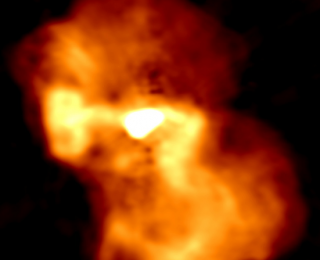
Check out these cool new results from LOFAR which is boldly going to some of the longest wavelengths astronomers have ever observed! An active galaxy has a less active past than we might expect, pulsating neutron stars are behaving strangely, and even at wavelengths as long as meters, there are still spectral lines from extremely low-energy atomic transitions.
The Hot, Irradiated Center of our Milky Way
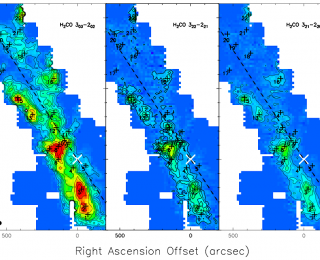
Unlike its candy bar namesake, the center of our Milky Way Galaxy is not actually a very pleasant place to be. There’s a supermassive central black hole to deal with, intense radiation from a population of massive stars, and hot clouds of molecular gas. In this paper, the authors use observations of three molecular spectral lines to measure the temperatures of these gas clouds in the center of the Galaxy, and find that the processes heating the clouds may not be what you expect!
No jets in the Galactic center?
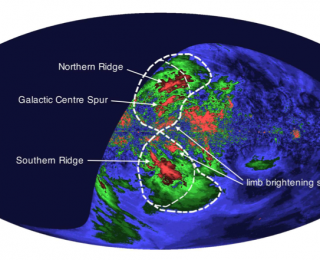
Carretti and collaborators have found new evidence that the gigantic bubbles of emission emanating from the center of our Milky Way are the result of winds from supernova explosions, not jets from our supermassive black hole.
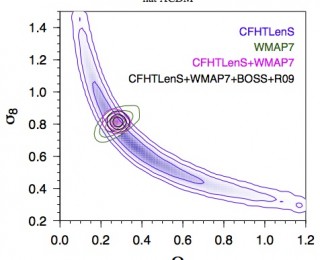
The strength of weak lensing
The Canada-France Hawaii Telescope weak gravitational lensing survey (CFHTLens), recently released new results to help constrain our cosmological models. While still in its early stages, weak lensing will ultimately be a powerful tool to discover the nature of the mysterious dark energy.
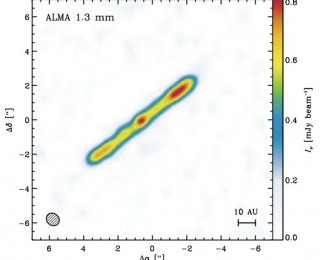
AU Mic through new ALMA glasses
I’ve got pretty bad eyesight. If I take off my glasses and look at the flowers on my window sill, they look like a fuzzy yellow blob. But with glasses, the petals and the patterns cast on them come into focus. This is how I felt when looking at the new observations of the debris disk around AU Mic. Putting on our ALMA glasses, the fuzzy debris disk around AU Mic is sharpening into something surprisingly consistent with our own Solar System.