by Yvette Cendes | Dec 16, 2013 | Daily Paper Summaries
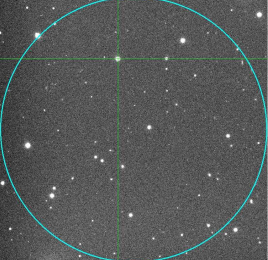
Title: Fast Radio Bursts May Originate from Nearby Flaring Stars Authors: Abraham Loeb, Yossi Shvartzvald, Dan Maoz First Author’s Institution: Institute for Theory and Computation, Harvard University Paper Status: MNRAS, in press One of the most intriguing discoveries in radio astronomy in recent years has been the discovery of Fast Radio Bursts (FRBs). Originally called Lorimer bursts after the first (and for some time, only) burst observed, there are currently six of these bursts published in the literature, and astronomers are puzzled because they look very different from any other astronomical signals observed before. They are bright- FRBs are the brightest astronomical phenomena seen in radio frequencies, and they don’t seem to have known counterparts in other wavelengths. They are brief- a burst only lasts a few microseconds, and they don’t seem to repeat. And they have a very high dispersion measure (DM)- a relationship between time and frequency that tells you how far away a signal comes from (explained well in this Astrobite)- which has indicated an extragalactic origin for FRBs. To writ, what exactly FRBs are and where they come from is a mystery.In this paper, the authors decided to take a different track from previous theories about FRB origins that point to extragalactic sources, and instead tackled the option of a much more local origin. Their proposed candidate sources are flare stars– variable stars which can undergo dramatic and unpredictable increases in brightness. Flare stars are typically dim dwarf stars, and some are already known to produce radio bursts with brief rise times on the order of milliseconds, thought to be produced by cyclotron maser mechanisms in the stellar atmospheres. ...
by Josh Fuchs | Nov 27, 2013 | Daily Paper Summaries
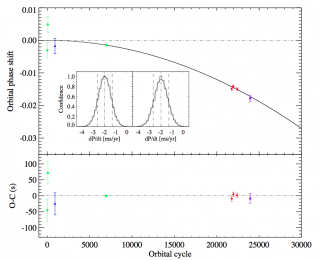
In today’s paper, the authors study how the periods of two black hole x-ray binaries are changing. They find that the periods are decaying faster than expected based on standard theoretical arguments.
by Korey Haynes | Nov 26, 2013 | Daily Paper Summaries
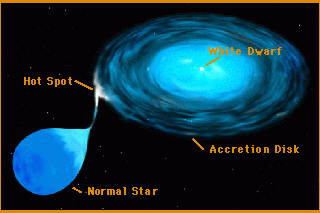
Cataclysmic variables are binary star systems where one of the stars—a white dwarf—devours its main sequence partner over time. Kepler proves yet again that it can find a lot more than just exoplanets by identifying a cataclysmic variable with a period of less than an hour.
by Josh Fuchs | Oct 31, 2013 | Daily Paper Summaries
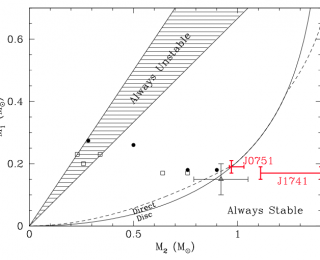
The progenitors of a special type of cataclysmic variable, AM CVn, and possibly supernovae have been found.
by Maria Drout | Oct 21, 2013 | Daily Paper Summaries
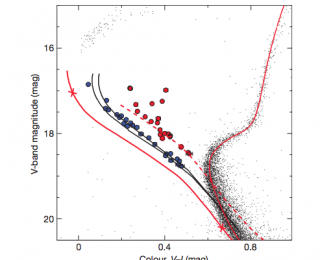
The authors identify two distinct sequences of blue straggler stars in the globular cluster NGC 392. They hypothesize that one branch is formed via stellar mergers and the other is binary stars undergoing mass transfer. This is the second globular cluster found to possess this double sequence.
by Nick Ballering | Oct 7, 2013 | Daily Paper Summaries
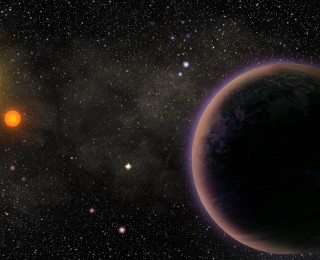
Dust traps may be the key to forming Kepler-16b and other circumbinary planets.
