• RSS
  • Submit a Guest Post
  • Undergraduates: Submit your Research!
  • Suggest a Paper Topic!
astrobites
  • About
    • About Astrobites
    • Meet the Authors
    • Statement of Inclusivity
    • Copyright & Permissions
  • Latest Research
    • Daily Paper Summaries
    • Classics
    • Undergrad Research
    • Physical Review Coverage
  • Beyond astro-ph
    • Beyond astro-ph Library
    • Interviews
    • Career Navigation
    • Personal Experiences
    • Current Events
    • Teaching with Astrobites
  • Guides
    • EM Spectrum
    • Galaxies & AGNs
    • Spectroscopy and Spectral Lines
    • Adaptive Optics
    • Gravitational Waves
    • Transient Astronomy
    • Astrophysical Software
    • Graduate School
    • Writing a personal statement for grad apps
    • First Observing Run
    • …More Guides!
Select Page
Unveiling the friend of a pulsar

Unveiling the friend of a pulsar

by Josh Fuchs | Jul 11, 2013 | Daily Paper Summaries

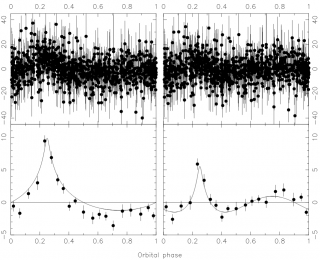
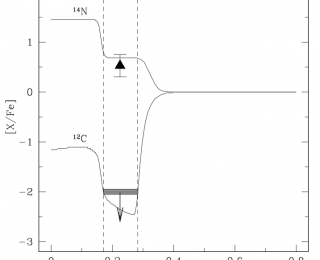
What kind of star is orbiting around a millisecond pulsar and where did it come from?

Using General Relativity to Measure Properties of Binary Pulsars

Using General Relativity to Measure Properties of Binary Pulsars

by Josh Fuchs | May 16, 2013 | Daily Paper Summaries

Shapiro time delays are one of the four tests of general relativity possible in the solar system. Astronomers can use these timing delays to measure properties of binary pulsar systems.
Checking Out Our New Neighbors

Checking Out Our New Neighbors

by Ben Montet | Apr 5, 2013 | Daily Paper Summaries

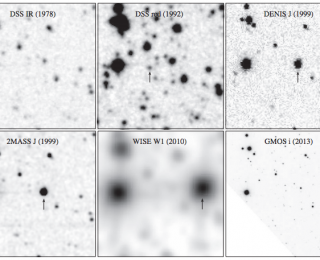
A new brown dwarf system has been discovered only 2 parsec away; Gillon et al. analyze its light curve to study clouds on the surfaces of these stars.
Exploding diamonds in the sky

Exploding diamonds in the sky

by Alice Olmstead | Feb 19, 2013 | Daily Paper Summaries

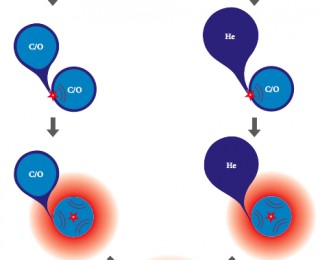
Pakmor et al. propose a new mechanism to make Type 1a supernova explosions from a pair of white dwarfs.
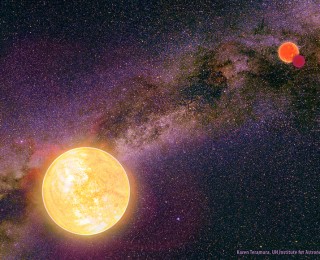
Three’s a Crowd: Potential Triple-Star Systems in the Kepler Field

Three’s a Crowd: Potential Triple-Star Systems in the Kepler Field

by Ben Montet | Feb 8, 2013 | Daily Paper Summaries

By looking for variations in the observed periods for eclipsing binary stars, astronomers have found evidence that a sizable fraction of these systems are actually systems of three or more stars.
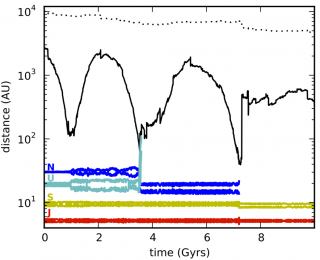
When Push Comes to Shove: How Wide Binaries Can Wreak Havoc on Planetary Systems

When Push Comes to Shove: How Wide Binaries Can Wreak Havoc on Planetary Systems

by Nick Ballering | Jan 28, 2013 | Daily Paper Summaries

New simulations show that — due to forces from outside the stellar system — wide stellar binaries may disrupt planets much more than previously thought.

« Older Entries
Next Entries »

Loading

Follow our socials

  • Bluesky
  • Facebook
  • Instagram
  • RSS Feed

More Posts About

AAS AGN astronomy astrophysics binary stars black holes cosmology dark matter dwarf galaxies exoplanets galaxies galaxy evolution gravitational waves habitability JWST Kepler Milky Way observations planetary science planet formation protoplanetary disks radio astronomy simulations solar system spectroscopy star formation stars stellar evolution supernovae theory

Posts by Category

  • Accessibility
  • Applications
  • Beyond
  • Book Reviews
  • Career Navigation
  • Classics
  • Climate Change
  • Course Assignments
  • Crossposts
  • Current Events
  • Daily Paper Summaries
  • Game Reviews
  • Guides
  • Historical Astronomy
  • Instrumentation
  • Interviews
  • Outreach
  • Personal Experiences
  • PRJ
  • Quick Notes
  • Satellites
  • Teaching
  • Undergraduate Research

More Astronomy

  • AAS
  • AAS Nova
  • astro-ph
  • AstroBetter
  • APOD

Read Astrobites in Other Languages

  • Astrobitos (Spanish)
  • Astropontos (Portuguese)
  • staryab (Farsi)

Listen to Astrobites

  • astro[sound]bites

Discover More Incredible Science

  • ScienceBites Network
  • RSS

© 2026 Astrobites | All Rights Reserved | Supported by AAS | Designed by Elegant Themes | Powered by WordPress