by Nathan Sanders | Apr 11, 2012 | Career Navigation
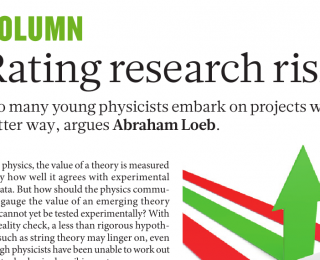
Abraham Loeb proposes the creation of “credit rating agencies” to evaluate the riskiness to young researches of emerging theories in physics.
by Caroline Morley | Oct 12, 2011 | Career Navigation
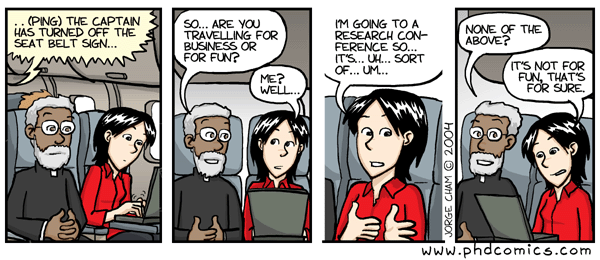
Last month I attended my first conference as a graduate student — I went to Extreme Solar Systems II (joined by my fellow Astrobites authors Courtney, Ellie, Lauren, and Sukrit). I learned a lot about what to do (and what not to do!) from my experiences during the conference.

by Maria Drout | Sep 8, 2011 | Career Navigation, Daily Paper Summaries
Title: Astronomy Career Profiles from the AAS Newsletter Archives Authors: Travis Metcalfe, Leila Belkora, Liam McDaid, Blake Bullock, Christine Pulliam, Peter Williams, Joshua Roth, Barb Whitney, Knut Olsen, Andy Howell, Luke Keller For those of you who feel like you have your life and your future completely figured out, I apologize in advance for this post. But ‘tis the season: the beginning of a new academic year, the time when many of you may be thinking about the next stage in your careers. Dan already wrote two fantastic posts this week about the process of applying to graduate school (here and here) but now I want to take a step back.Going to graduate school is a large commitment, and making the decision to do so can be a stressful process. In astronomy, in particular, I have encountered numerous students plagued by a series of ‘what ifs’, all of which seem to stem from a basic misconception about what going to astronomy graduate school actually means for your future.To help frame this misconception, I pose the following question to all of you thinking of pursuing astronomy, “What’s the point?” This may seem like a very philosophical question, and it is, but I guarantee that at some point in your career you will be asked to justify what you do to a “layman”. So start working on your answer now. And let me warn you: it is quite frankly harder in astronomy than some other sciences. Although space cowboys on asteroids are pretty cool, it is my opinion that we can’t really just default to, “some day this research will save...
by Guest | Aug 15, 2011 | Career Navigation
We again have the pleasure of having John Johnson write today on astrobites. We were curious to get his opinion on several topics; in this first post, he’ll answer our questions about life in graduate school. We asked what he wished he’d known going into graduate school, how he balanced work and life, and what he did in grad school that he thinks were beneficial later on.
by Nathan Goldbaum | May 14, 2011 | Career Navigation
Today I have the pleasure to introduce one of our faculty members here at UC Santa Cruz to the Astrobites community. Jonathan Fortney is an expert on the atmospheres and interiors of giant planets and has a unique perspective on the process of science in a newly emerging field. Instead of a specific scientific topic, Jonathan wanted to impart some wisdom on the criteria he uses to choose a research topic to work on.“For my scientific temperament I needed a field that was more controversial, more open-ended and new, where quick was useful and sloppy did not matter too much because it would all change soon anyway.” –Ed Salpeter (ARAA, 2002, 40:1–25)When scientists write about their own work and their careers, you can learn a lot from their experience. Given all the writing that scientists do, it is unfortunately rare for someone to actually write about the science they do, rather than just reporting results and ramifications. There is precious little written about why a certain problem was chosen or why the astronomer found it interesting in the first place.From time to time I like to read through what I call the “looking back on my career” article in the Annual Review of Astronomy and Astrophysics. There is one of these every year. They get a famous astronomer to write about the highs (and lows?) of their careers. I’ve read a several of these, from giants in the field like Ed Salpeter and Al Cameron. You get a good feel for what the exciting questions were at various points of their careers, and how that changed the focus of...
