• RSS
  • Submit a Guest Post
  • Undergraduates: Submit your Research!
  • Suggest a Paper Topic!
astrobites
  • About
    • About Astrobites
    • Meet the Authors
    • Statement of Inclusivity
    • Copyright & Permissions
  • Latest Research
    • Daily Paper Summaries
    • Classics
    • Undergrad Research
    • Physical Review Coverage
  • Beyond astro-ph
    • Beyond astro-ph Library
    • Interviews
    • Career Navigation
    • Personal Experiences
    • Current Events
    • Teaching with Astrobites
  • Guides
    • EM Spectrum
    • Galaxies & AGNs
    • Spectroscopy and Spectral Lines
    • Adaptive Optics
    • Gravitational Waves
    • Transient Astronomy
    • Astrophysical Software
    • Graduate School
    • Writing a personal statement for grad apps
    • First Observing Run
    • …More Guides!
Select Page
DAMPE cosmic ray spectrum may shed light on dark matter

DAMPE cosmic ray spectrum may shed light on dark matter

by Kelly Malone | Dec 7, 2017 | Daily Paper Summaries

Today’s paper has implications for theories of dark matter and nearby pulsars.

Ancient Trees: A New Kind of Cherenkov Telescope

Ancient Trees: A New Kind of Cherenkov Telescope

by Thankful Cromartie | Dec 4, 2017 | Daily Paper Summaries

Astronomy research can be conducted in countless ways, but when’s the last time you chopped into a tree to learn about the cosmos?
The Science of the Next Generation

The Science of the Next Generation

by Kelly Malone | Oct 2, 2017 | Daily Paper Summaries

Today we’re delving into the future of gamma-ray astrophysics by discussing the science goals of the next-generation experiment.
Can we see neutrinos from the star-forming region Cygnus?

Can we see neutrinos from the star-forming region Cygnus?

by Kelly Malone | Apr 13, 2017 | Daily Paper Summaries

Today’s bite discusses neutrinos from a particularly interesting region of the sky: the Cygnus X region.
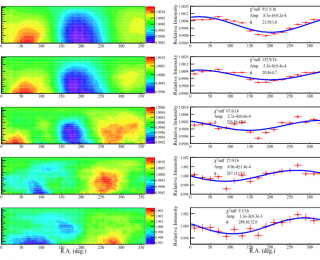
Anisotropies in our galaxy

Anisotropies in our galaxy

by Kelly Malone | Feb 2, 2017 | Daily Paper Summaries

Today’s bite gives an update on the cosmic ray anisotropy, which could tell us more about the origins of cosmic rays.
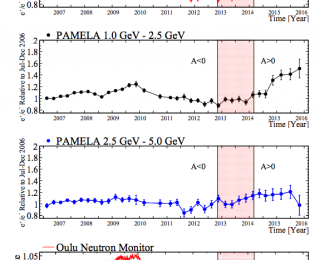
How the Sun influences the positron fraction

How the Sun influences the positron fraction

by Kelly Malone | Aug 31, 2016 | Daily Paper Summaries

Positron fraction measurements from the 90s don’t match more recent data. The PAMELA team presents an explanation as to why that is – and it has to do with our sun.

« Older Entries
Next Entries »

Loading

Follow our socials

  • Bluesky
  • Facebook
  • Instagram
  • RSS Feed

More Posts About

AAS AGN astronomy astrophysics binary stars black holes cosmology dark matter dwarf galaxies exoplanets galaxies galaxy evolution gravitational waves habitability JWST Kepler Milky Way observations planetary science planet formation protoplanetary disks radio astronomy simulations solar system spectroscopy star formation stars stellar evolution supernovae theory

Posts by Category

  • Accessibility
  • Applications
  • Beyond
  • Book Reviews
  • Career Navigation
  • Classics
  • Climate Change
  • Course Assignments
  • Crossposts
  • Current Events
  • Daily Paper Summaries
  • Game Reviews
  • Guides
  • Historical Astronomy
  • Instrumentation
  • Interviews
  • Outreach
  • Personal Experiences
  • PRJ
  • Quick Notes
  • Satellites
  • Teaching
  • Undergraduate Research

More Astronomy

  • AAS
  • AAS Nova
  • astro-ph
  • AstroBetter
  • APOD

Read Astrobites in Other Languages

  • Astrobitos (Spanish)
  • Astropontos (Portuguese)
  • staryab (Farsi)

Listen to Astrobites

  • astro[sound]bites

Discover More Incredible Science

  • ScienceBites Network
  • RSS

© 2026 Astrobites | All Rights Reserved | Supported by AAS | Designed by Elegant Themes | Powered by WordPress