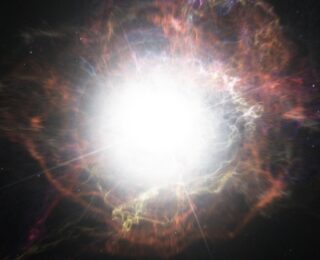
Invisible Tripwires in a Minefield: Could Dark Matter Ignite White Dwarfs?
Could dark matter be responsible for spontaneously exploding white dwarfs? Find out in today’s bite about Ca-rich gap transients!

Could dark matter be responsible for spontaneously exploding white dwarfs? Find out in today’s bite about Ca-rich gap transients!
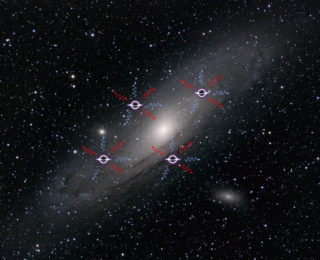
If extremely low-mass primordial black holes are lurking in our galaxy, they should glow white hot with Hawking radiation. Today’s authors explore whether we can use this fact to tease out their presence.
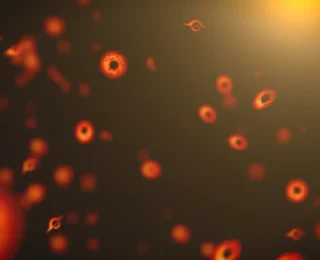
It turns out that just about anything can be a dark matter detector! Tiny tunnels in materials could be indicative of primordial black holes (PBHs) whizzing through the universe.
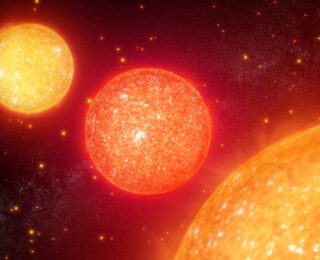
How can astronomers use existing understandings of stellar evolution to better study dark matter?
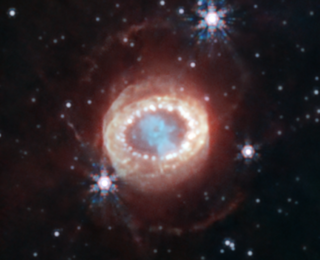
When we cannot measure particles directly, we have to look for their radiation byproducts. Today’s authors investigate the possibility of detecting dark matter being converted into gamma rays by the the most famous supernova’s remnant.

Gravitational lensing is a natural result and unique feature of Einstein’s theory of general relativity. It is also an important instrument in the cosmologist’s toolkit. Today’s paper highlights one way astronomers are using gravitational lensing to study dark matter.