• RSS
  • Submit a Guest Post
  • Undergraduates: Submit your Research!
  • Suggest a Paper Topic!
astrobites
  • About
    • About Astrobites
    • Meet the Authors
    • Statement of Inclusivity
    • Copyright & Permissions
  • Latest Research
    • Daily Paper Summaries
    • Classics
    • Undergrad Research
    • Physical Review Coverage
  • Beyond astro-ph
    • Beyond astro-ph Library
    • Interviews
    • Career Navigation
    • Personal Experiences
    • Current Events
    • Teaching with Astrobites
  • Guides
    • EM Spectrum
    • Galaxies & AGNs
    • Spectroscopy and Spectral Lines
    • Adaptive Optics
    • Gravitational Waves
    • Transient Astronomy
    • Astrophysical Software
    • Graduate School
    • Writing a personal statement for grad apps
    • First Observing Run
    • …More Guides!
Select Page
Missing dark matter in a nearby dwarf galaxy

Missing dark matter in a nearby dwarf galaxy

by Roan Haggar | Jul 7, 2021 | Daily Paper Summaries

A satellite of Andromeda is missing an important ingredient — so where did it go?

UR: A Search for Dark Matter with HaloSat

UR: A Search for Dark Matter with HaloSat

by Guest | May 9, 2021 | Undergraduate Research

In the latest of our #UndergradResearch series, discover how Emily Silich used observations from the HaloSat cubesat to search for X-ray signatures of dark matter.
How to Make Genetically Engineered Halos in Cosmological Simulations

How to Make Genetically Engineered Halos in Cosmological Simulations

by Guest | May 3, 2021 | Daily Paper Summaries

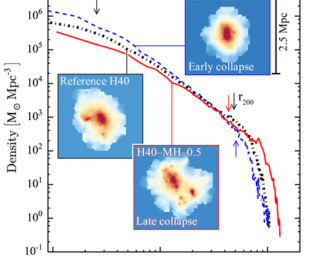
Today’s guest post takes a look at a technique that cleverly tweaks simulated galaxy halos very early on in their lives in order to direct their growth in a specific way
Hunting for stellar splashback: defining the size of a galaxy cluster

Hunting for stellar splashback: defining the size of a galaxy cluster

by Katy Proctor | Mar 17, 2021 | Daily Paper Summaries

How big is a galaxy cluster? Today’s authors use the remnants of destroyed galaxies to define the edge of galaxy clusters.
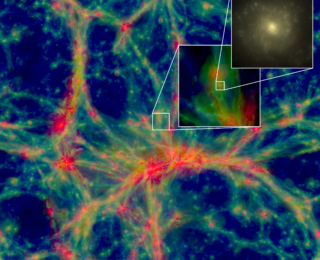
The Galaxy Main Sequence: What’s in the Scatter?

The Galaxy Main Sequence: What’s in the Scatter?

by Katy Proctor | Jan 30, 2021 | Daily Paper Summaries

What processes can explain the diversity in star formation rates exhibited by galaxies of similar masses? Today’s authors investigate this using the EAGLE simulation.
Meet the AAS Keynote Speakers: Adrian Price-Whelan

Meet the AAS Keynote Speakers: Adrian Price-Whelan

by Michael Foley | Jan 10, 2021 | Career Navigation, Current Events, Personal Experiences

Thanks to the Gaia satellite and other incredible data sources, we are in for a set of unprecedented discoveries about our galaxy over the next few years. Learn more about them at Dr. Adrian Price-Whelan’s talk at #AAS237!

« Older Entries
Next Entries »

Loading

Follow our socials

  • Bluesky
  • Facebook
  • Instagram
  • RSS Feed

More Posts About

AAS AGN astronomy astrophysics binary stars black holes cosmology dark matter dwarf galaxies exoplanets galaxies galaxy evolution gravitational waves habitability JWST Kepler Milky Way observations planetary science planet formation protoplanetary disks radio astronomy simulations solar system spectroscopy star formation stars stellar evolution supernovae theory

Posts by Category

  • Accessibility
  • Applications
  • Beyond
  • Book Reviews
  • Career Navigation
  • Classics
  • Climate Change
  • Course Assignments
  • Crossposts
  • Current Events
  • Daily Paper Summaries
  • Game Reviews
  • Guides
  • Historical Astronomy
  • Instrumentation
  • Interviews
  • Outreach
  • Personal Experiences
  • PRJ
  • Quick Notes
  • Satellites
  • Teaching
  • Undergraduate Research

More Astronomy

  • AAS
  • AAS Nova
  • astro-ph
  • AstroBetter
  • APOD

Read Astrobites in Other Languages

  • Astrobitos (Spanish)
  • Astropontos (Portuguese)
  • staryab (Farsi)

Listen to Astrobites

  • astro[sound]bites

Discover More Incredible Science

  • ScienceBites Network
  • RSS

© 2026 Astrobites | All Rights Reserved | Supported by AAS | Designed by Elegant Themes | Powered by WordPress