by David Wilson | Sep 28, 2015 | Daily Paper Summaries
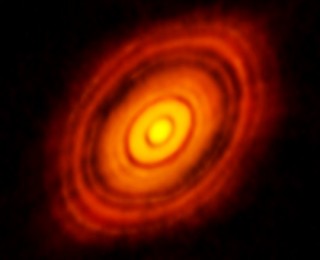
Nearly a year ago, the ALMA collaboration released this stunning image of the young star HL Tau. The sub-millimeter wavelengths of light that ALMA detects revealed a vast disc of gas and dust, several times larger than Neptune’s orbit. Intriguingly, the disc was divided up into a series of well-defined, concentric rings.
The cause of the rings seemed clear: There must be planets around HL Tau, their gravity sculpting the gas and sweeping out the dark gaps in the disc.
by Michael Zevin | Sep 22, 2015 | Daily Paper Summaries
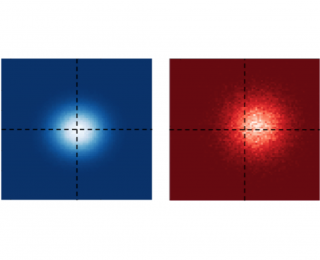
There are more moons than planets in our Solar System that harbor liquid water, and these moons may offer us the best chances of finding life off of Earth. Today’s paper takes the search for habitable moons a step further by investigating how telescopes of the near future might allow us to see and characterize these moons around exoplanets.
by Erika Nesvold | Dec 13, 2013 | Daily Paper Summaries
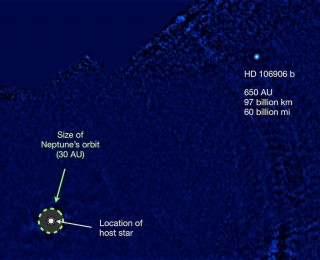
The Magellan telescope has directly imaged a planetary-mass companion at a projected distance of 650 AU from its star! Read on to find out how the authors detected and characterized this companion, and how they think it got there.
by Ben Montet | Sep 20, 2013 | Daily Paper Summaries
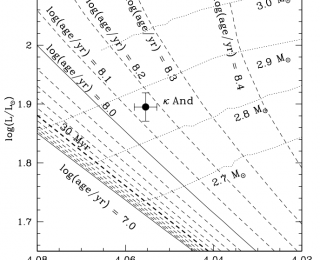
A “Super-Jupiter” recently discovered by direct imaging techniques may not be as it initially seemed. Hinkley et al. find the system to be older than expected and the Super-Jupiter to really be a brown dwarf.
by Nick Ballering | Jul 15, 2013 | Daily Paper Summaries
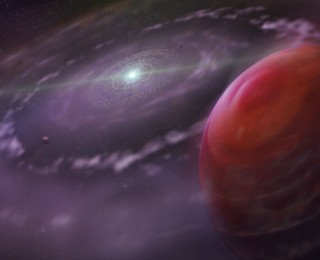
The mass of the cores of giant planets affects their luminosity after formation, complicating how we determine the mass of directly imaged planets.
by Caroline Morley | Mar 15, 2013 | Daily Paper Summaries
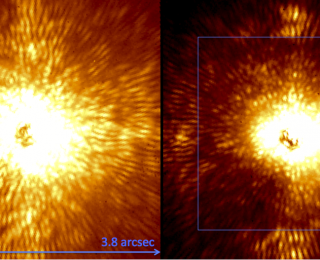
Two years ago this month, I wrote my very first astrobite about the puzzlingly cloudy atmosphere of the outermost planet, HR 8799b; today I’m revisiting the system and looking at a recent paper which measured spectra of not just one planet, but the entire planetary system. This is the first comparative spectroscopic study of any multi-planet system (other than our own Solar System of course).
