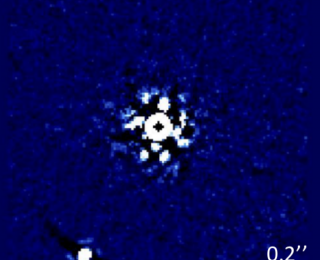
New Directly Imaged Planet Challenges Planet Formation Theories
HIP 65426 b is the first planet discovered with the SPHERE imager on the VLT. It is an intriguing planet for future study of cloud formation but how did it form in the first place?

HIP 65426 b is the first planet discovered with the SPHERE imager on the VLT. It is an intriguing planet for future study of cloud formation but how did it form in the first place?
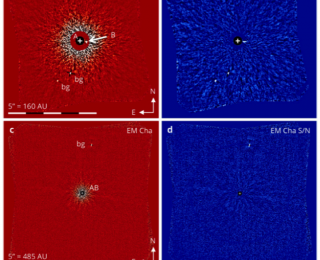
Ever wondered whether the planet Tatooine could be real? In today’s paper, the authors discuss a new technique to directly image distinct planets orbiting binary stars, just like in Star Wars.
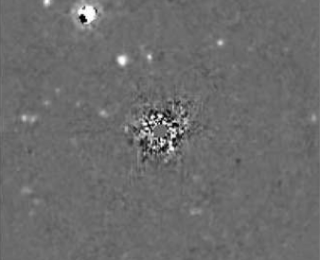
We know quite a lot about planets orbiting other stars – if they’re closer to their stars than Jupiter is to the Sun. For the region further out than Pluto, we know almost nothing. Is there anything out there?
Orbital stability of high-mass multi-planet systems is scrutinized in comparison to their low-mass counterparts.
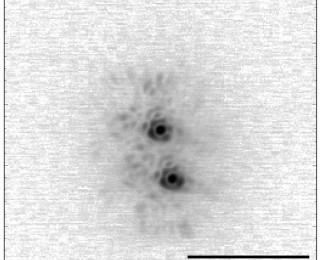
For several years now, there has been considerable interest in circumbinary planets – that is to say, planets that orbit both stars in a binary system. They pose many interesting questions, such as, “How does their formation differ from planets in single-star systems?”, “What will happen to them when the stars evolve?”, and of course, “Could humans live there?” It was because of questions like these that the authors of today’s paper turned their telescopes on KIC 7177553.
The third Extreme Solar System conference was held between Nov 29 to Dec 4th, in Kona, Hawaii, on the 20th anniversary of the first exoplanet detection around a main sequence star. This astrobite gives a brief overview of the conference.