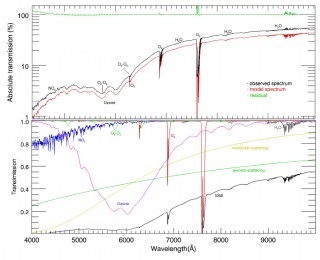
Earth as an exoplanet via the Moon
It sounds convoluted: today’s astrobite observed a lunar eclipse in order to learn about the Earth’s atmosphere, to understand more about how to observe exoplanets. How and why do they do this? Read on…

It sounds convoluted: today’s astrobite observed a lunar eclipse in order to learn about the Earth’s atmosphere, to understand more about how to observe exoplanets. How and why do they do this? Read on…
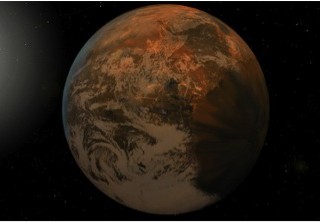
This paper asks what the biosphere of the Earth will look like billions of years from now, when the era of life is ending. What biosignatures might we detect from a dying planet?
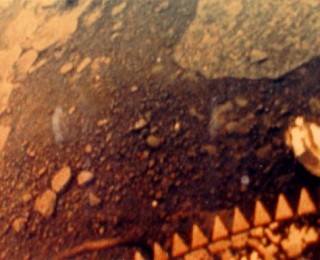
This paper considers the possibility that Earth could suffer a runaway or moist greenhouse effect, which probably turned Venus into a hellish wasteland long ago.
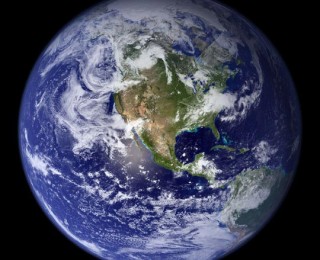
It took homo sapiens hundreds of thousands of years on the planet to understand a fundamental, simple-sounding, question: how old is the Earth? The answer to this question has gone down in the history books as one of the most important geophysical and astrophysical discoveries of the past century. This paper, by Clair Patterson in 1956, is credited with providing the first accurate, measured age of the Earth.
Venus transits the Sun, from the frame of the Earth, about twice every century, separated by eight years. The last one happened in 2004, and another is happening in June 2012. Observing the transmission spectrum during the 2012 transit—and comparing it to measured transmission spectra of the Earth, taken during lunar eclipses—will tell us how hard it will be to distinguish two planets that look identical in mass and radius, but have extremely different atmospheric properties.
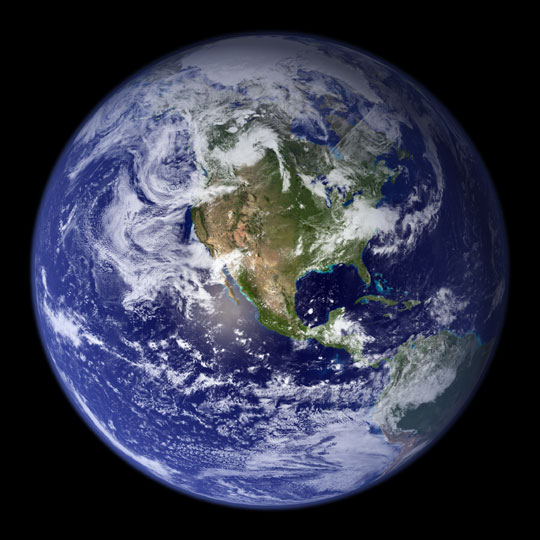
Assuming that we have acquired the spectrum of a distant terrestrial planet, what would it look like? Would we able to resolve surface features? More excitingly, would we be able to detect biomarkers in the atmospheres of alien Earths?