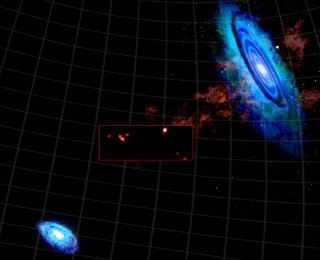
Mysterious Gas Clouds between M31 and M33
Seven gas clouds have been found in the region between two galaxies. Are they part of a intergalactic filament or remnants from a past galaxy interaction?

Seven gas clouds have been found in the region between two galaxies. Are they part of a intergalactic filament or remnants from a past galaxy interaction?
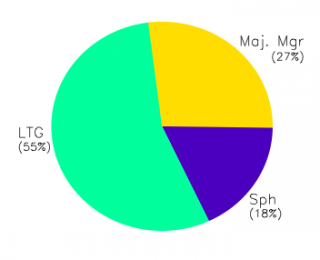
In this study, Kaviraj et al. find that major mergers only contribute a small percentage (17-27%) of the total star formation at a redshift of 2, when the Universe was 3.3 billion years old and vigorously creating new stars. This goes against what we once thought, and leaves the door open for other mechanisms to drive the global star formation rate in the early Universe.
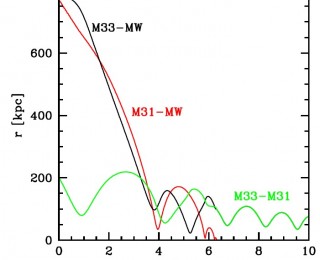
HST measurements of stellar proper motions in M31 reveal that the Andromeda galaxy is in radial (head-on collision) orbit towards the Milky Way. The huge strike will happen 4 billion years from now according to the simulations. It will likely affect also the environment of the Sun and the location of the solar system.
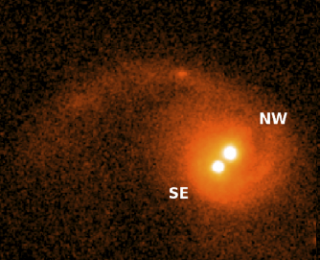
It has long been known that galaxies can merge; thus, we should expect their central supermassive black holes to interact as well. However, our ability to study this is limited as most mergers happen in the distant universe. The exceptional nearby source CID-42 can be explained by a recent binary or triple supermassive black hole interaction, giving astronomers a rare chance to witness the repercussions of such an event.
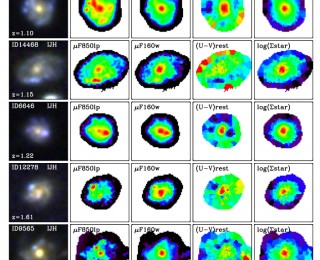
The lack of observed major mergers at high-redshift has prompted discussion of inside-out growth, that is, galaxies building up their stellar populations by cold gas accretion, starting in the inner regions and gradually moving outwards. This picture is far from settled, however, and so the authors of this paper set out to investigate whether or not the observations match the theory.
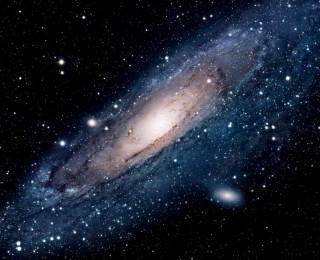
A specific class of elliptical galaxies called compact ellipticals, or cEs, are unusually compressed. Some speculate that these galaxies are petite because their outer layers have been stripped away by a neighboring galaxy; however, an alternative theory claims that these are regular elliptical galaxies that simply formed small and never contained stars in their outer regions. In order to differentiate between these two models, Howley et al. 2012 measured the dynamics of individual stars in one of our nearest neighbors, the compact elliptical M32.