by Nathan Sanders | Jan 23, 2012 | Daily Paper Summaries
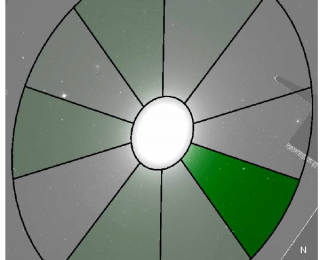
We think many galaxies we see today had mergers and interactions in their past, but how can we know for sure? Bonfini et al. look to evidence from a subtle pattern in the distribution of globular clusters in NGC 4261.
by Elizabeth Lovegrove | Jan 17, 2012 | Daily Paper Summaries
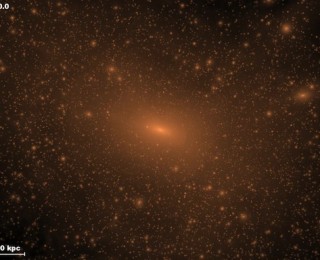
Dark matter is not so dark as the name might imply. Although it so far refuses to interact with normal matter via any force other than gravity, there are secondary signals that we can detect. When we turn our gamma-ray telescopes on regions like the Galactic Center that contain a high density of dark matter, we expect to see a dim, widespread gamma ray haze coming from seemingly empty space, with no baryonic matter source. This paper, due to be published by the Astrophysical Journal, discusses the search for this signature by the collection of satellites that surrounds the Milky Way, and uses the lack of a detection to set an upper limit on the cross-section of the WIMP particle.
by Elisabeth Newton | Nov 9, 2011 | Daily Paper Summaries
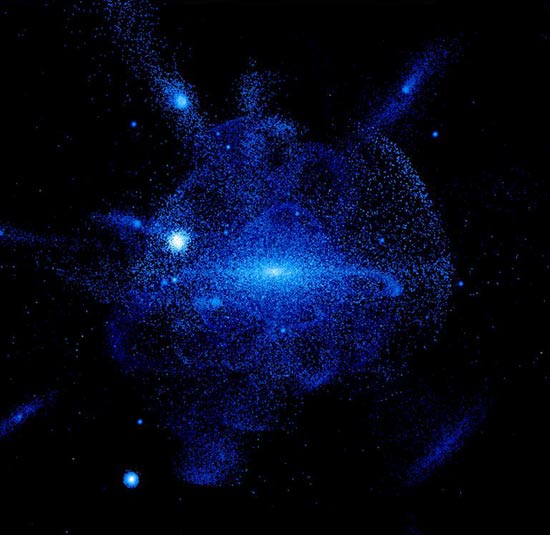
The Milky Way’s stellar halo – a roughly spherical distribution of stars surrounding our spiral galaxy – is a valuable tool for probing the early evolution of our galaxy. The stellar halo contains some of the oldest stars in our galaxy, whose properties reflect that of the environment in which they formed. This paper focuses on using cosmological simulations of galaxy formation to match the observed structure and kinematics (how the stars move) of stars in Milky Way’s halo.
by Aaron Bray | Aug 6, 2011 | Daily Paper Summaries
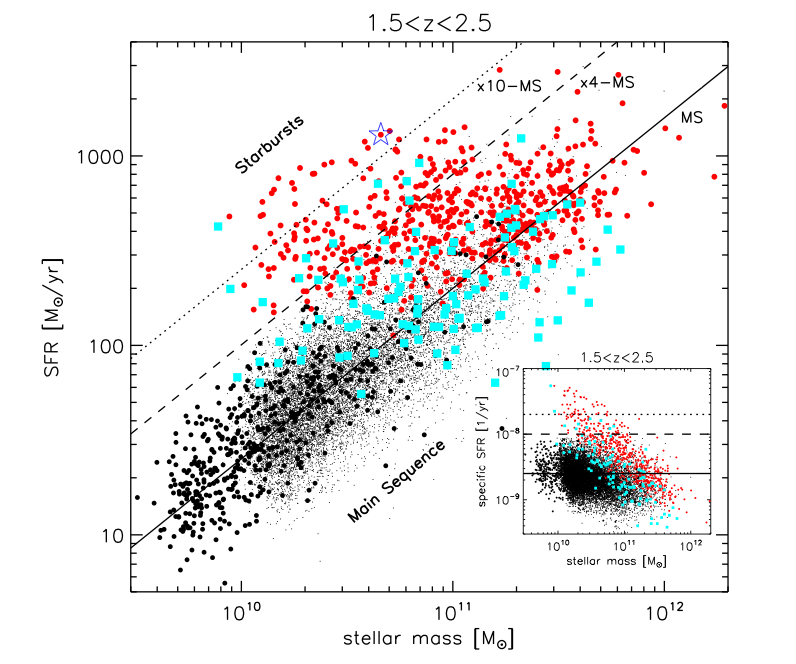
Starbursting galaxies are dramatic, but they may not be as important to the universe’s global star formation history as the more common spirals with their slow but steady stellar output.
by Evan Schneider | Aug 1, 2011 | Daily Paper Summaries
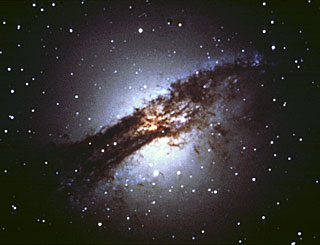
With the help of citizen science through Galaxy Zoo, this paper’s authors collect a large sample of dusty elliptical galaxies, which allows them to investigate the connection between gas-rich mergers, starbursts, and AGN activity.
by Nathan Goldbaum | Jul 17, 2011 | Daily Paper Summaries
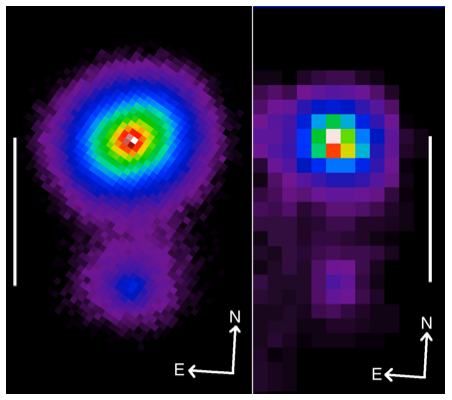
While there are many examples of AGN pairs with relatively large separations, there are (including the object discussed in this paper) currently only six known closely separated pairs. Unless there are many more undiscovered closely separated AGN pairs, something must be seriously wrong with our theoretical understanding of galaxy mergers and black hole growth.
