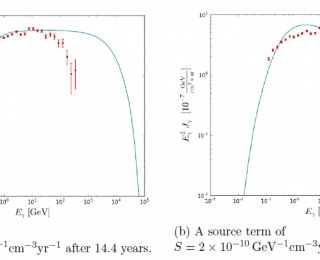
UR #18: Gamma-rays From Fermi Bubbles
This month’s undergraduate research post features a student who modeled high-energy gamma-ray emission from the Fermi Bubbles at the center of the Milky Way. Read on to find out more!

This month’s undergraduate research post features a student who modeled high-energy gamma-ray emission from the Fermi Bubbles at the center of the Milky Way. Read on to find out more!
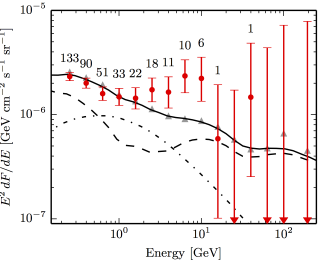
If dark matter particles can collide to release gamma-rays, the best place to see them will be in the centers of dwarf galaxies. Archival Fermi-LAT images around Reticulum 2 show the first ever detection of gamma-rays from a dwarf galaxy. Dark matter detection may be close at hand!
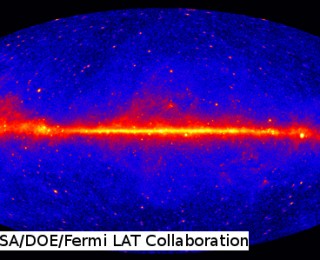
For a few years now, excess emission of gamma-rays in the direction of the Galactic Center has puzzled scientists. In the paper we discuss today, the authors re-analyze data from the Fermi telescope to get new insights into the origin of this excess emission. They make the case for the signal being described by dark matter particles annihilating in the center of our Galaxy.
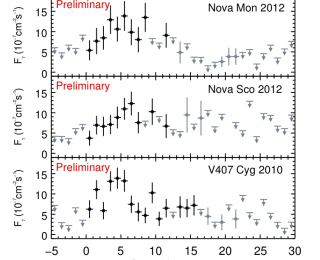
In 2010 the Fermi-LAT reported a surprising discovery: detection of a gamma ray transient that appeared to come from a nova, V407 Cyg. Since V407 Cyg is a special type of nova, however, it was considered a one-off event. Now two other classical novae have also been found in gamma rays.
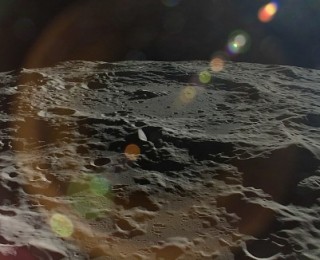
I’m going to go ahead and give away the punchline: the answer to this post’s title is, “If your source is within 8 degrees of the Moon, quite probably.” — at least according to this paper’s authors. Read on to find out why!
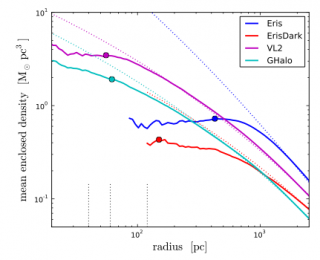
As Astrobites reported a couple of months ago, the Fermi-LAT gamma-ray telescope has reported an anomalous peak at 130 GeV, which could be the long-sought annihilation signature of dark matter. However, one of the strongest critiques of this potential discovery is that the signal is not coming from Sgr A*, the dynamical center of the Milky Way, but rather from about 200 parsecs away. Kuhlen et al. challenge the idea that the dark matter peak must be located at the dynamical center, and find that the combined dark matter-baryonic matter simulation Eris shows a well-defined, consistent offset between its dark matter peak and dynamical center.