• RSS
  • Submit a Guest Post
  • Undergraduates: Submit your Research!
  • Suggest a Paper Topic!
astrobites
  • About
    • About Astrobites
    • Meet the Authors
    • Statement of Inclusivity
    • Copyright & Permissions
  • Latest Research
    • Daily Paper Summaries
    • Classics
    • Undergrad Research
    • Physical Review Coverage
  • Beyond astro-ph
    • Beyond astro-ph Library
    • Interviews
    • Career Navigation
    • Personal Experiences
    • Current Events
    • Teaching with Astrobites
  • Guides
    • EM Spectrum
    • Galaxies & AGNs
    • Spectroscopy and Spectral Lines
    • Adaptive Optics
    • Gravitational Waves
    • Transient Astronomy
    • Astrophysical Software
    • Graduate School
    • Writing a personal statement for grad apps
    • First Observing Run
    • …More Guides!
Select Page
How to use gravitational waves to test if Einstein was right

How to use gravitational waves to test if Einstein was right

by Guest | Mar 16, 2022 | Daily Paper Summaries

The quest for the true nature of gravity continues! Can gravitational waves help us find the right answer? Today’s paper describes how this could work.

Catching Slippery Gravity with Fast Radio Bursts

Catching Slippery Gravity with Fast Radio Bursts

by Ryan Golant | Sep 14, 2021 | Daily Paper Summaries

Why is the Universe’s expansion accelerating? We have no idea! But, maybe fast radio bursts can provide some clues.
A cosmic footrace: testing the speed(s) of light with FRBs

A cosmic footrace: testing the speed(s) of light with FRBs

by Alex Gough | May 20, 2021 | Daily Paper Summaries

General relativity has stood the test of time for over a century. How can we continue to stress-test it using fast radio bursts? Today’s paper does just that!
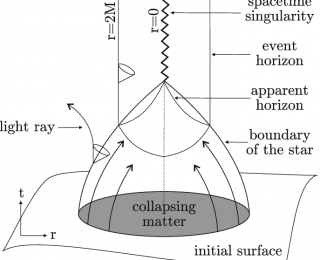
From Dust Bunnies to Black Holes: Oppenheimer-Snyder Collapse

From Dust Bunnies to Black Holes: Oppenheimer-Snyder Collapse

by Ryan Golant | Apr 9, 2021 | Classics, Daily Paper Summaries

In this summary of a classic paper from 1939, we look back at the very first theory of black hole formation: Oppenheimer and Snyder’s model of a spherically collapsing ball of dust.
Galaxies In More Crowded Environments Rotate Slower: Implications For Gravity

Galaxies In More Crowded Environments Rotate Slower: Implications For Gravity

by Guest | Mar 25, 2021 | Daily Paper Summaries

Was Einstein right that experiments behave the same in deep space as in an elevator freely falling on Earth, or does the gravity in the latter case matter? Find out about an observational test in today’s guest post by Indranil Banik.
Warp Drives!

Warp Drives!

by Wynn Jacobson-Galan | Mar 23, 2021 | Daily Paper Summaries

The speed of light is just a number!

« Older Entries
Next Entries »

Loading

Follow our socials

  • Bluesky
  • Facebook
  • Instagram
  • RSS Feed

More Posts About

AAS AGN astronomy astrophysics binary stars black holes cosmology dark matter dwarf galaxies exoplanets galaxies galaxy evolution gravitational waves habitability JWST Kepler Milky Way observations planetary science planet formation protoplanetary disks radio astronomy simulations solar system spectroscopy star formation stars stellar evolution supernovae theory

Posts by Category

  • Accessibility
  • Applications
  • Beyond
  • Book Reviews
  • Career Navigation
  • Classics
  • Climate Change
  • Course Assignments
  • Crossposts
  • Current Events
  • Daily Paper Summaries
  • Game Reviews
  • Guides
  • Historical Astronomy
  • Instrumentation
  • Interviews
  • Outreach
  • Personal Experiences
  • PRJ
  • Quick Notes
  • Satellites
  • Teaching
  • Undergraduate Research

More Astronomy

  • AAS
  • AAS Nova
  • astro-ph
  • AstroBetter
  • APOD

Read Astrobites in Other Languages

  • Astrobitos (Spanish)
  • Astropontos (Portuguese)
  • staryab (Farsi)

Listen to Astrobites

  • astro[sound]bites

Discover More Incredible Science

  • ScienceBites Network
  • RSS

© 2026 Astrobites | All Rights Reserved | Supported by AAS | Designed by Elegant Themes | Powered by WordPress