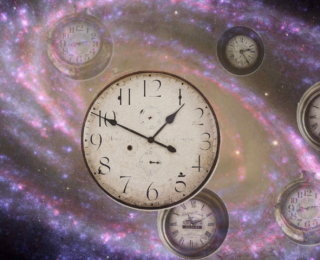
Measuring the curvature of the Universe with cosmic clocks
What is the curvature of the Universe? Today’s authors use an exciting new probe to find out: Cosmological Clocks.

What is the curvature of the Universe? Today’s authors use an exciting new probe to find out: Cosmological Clocks.
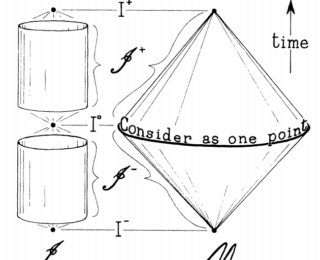
In today’s classic paper – Nobel laureate Roger Penrose fits the whole universe on a page!
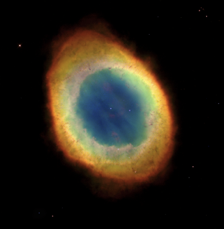
Today’s undergraduate research post features a student who measures the white dwarf mass-radius relation using thousands of stars and a neat effect predicted by general relativity
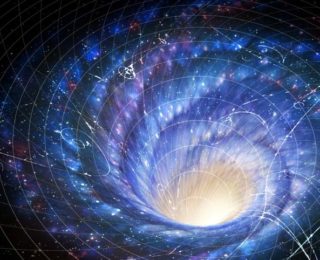
No dark matter, no modified gravitation, just general relativity. Let’s see what we can get in disk galaxies.
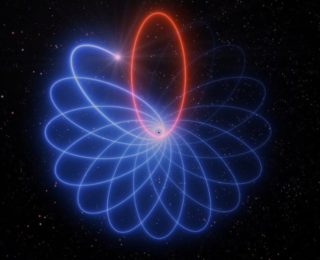
The GRAVITY team first detects the Schwarzschild precession of the orbit of the star S2 in the center of the Milky Way.
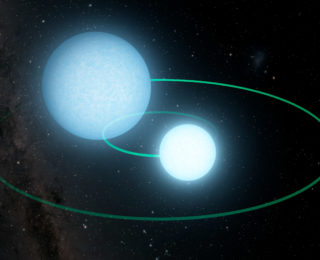
The Zwicky Transient Factory (ZTF) observes the entire northern sky and collects data on as many stars as possible. Combing through the light curves of 20 million stars with periodic changes in brightness, the authors of today’s paper found a hidden gem called ZTF J1539+5027, an eclipsing white dwarf binary with an orbital period of only 6.91 minutes.