• RSS
  • Submit a Guest Post
  • Undergraduates: Submit your Research!
  • Suggest a Paper Topic!
astrobites
  • About
    • About Astrobites
    • Meet the Authors
    • Statement of Inclusivity
    • Copyright & Permissions
  • Latest Research
    • Daily Paper Summaries
    • Classics
    • Undergrad Research
    • Physical Review Coverage
  • Beyond astro-ph
    • Beyond astro-ph Library
    • Interviews
    • Career Navigation
    • Personal Experiences
    • Current Events
    • Teaching with Astrobites
  • Guides
    • EM Spectrum
    • Galaxies & AGNs
    • Spectroscopy and Spectral Lines
    • Adaptive Optics
    • Gravitational Waves
    • Transient Astronomy
    • Astrophysical Software
    • Graduate School
    • Writing a personal statement for grad apps
    • First Observing Run
    • …More Guides!
Select Page

The First Image of a Black Hole

by Guest | Apr 11, 2019 | Daily Paper Summaries

The Event Horizon Telescope has observed the supermassive black hole at the center of M87, producing the first-ever image of a black hole and marking the beginning of a new era in astronomy.

What does a neutron star actually look like?

What does a neutron star actually look like?

by Lisa Drummond | Nov 19, 2018 | Daily Paper Summaries

Ever wondered what a neutron star would look like up close? Here is your answer!
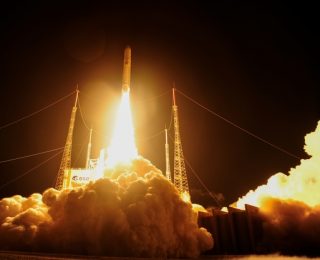
BepiColombo blasts off in pursuit of Einstein

BepiColombo blasts off in pursuit of Einstein

by Philippa Cole | Oct 29, 2018 | Daily Paper Summaries

A joint European and Japanese mission to Mercury sets off to answer questions about the planet’s geology, magnetosphere, and to try and prove Einstein wrong.
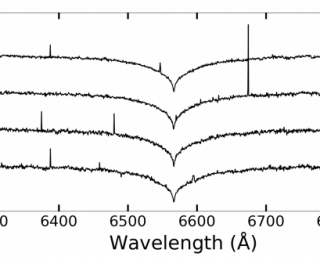
Gravitational Redshift and the Pup: Measuring the Mass of Sirius B

Gravitational Redshift and the Pup: Measuring the Mass of Sirius B

by Daniel Berke | Oct 2, 2018 | Daily Paper Summaries

Measuring a white dwarf’s gravitational redshift can help us figure out its mass, but for one of the closest stars to us (Sirius B) the numbers didn’t match with other methods. Today’s paper investigates the discrepancy.
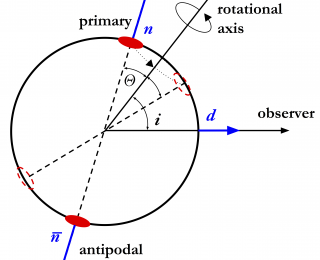
Photons from the “Dark Side” of Neutron Stars Could Help Unravel a Supernuclear Mystery

Photons from the “Dark Side” of Neutron Stars Could Help Unravel a Supernuclear Mystery

by Thankful Cromartie | Jul 27, 2018 | Daily Paper Summaries

What can we learn from a compact object that shows us all of its sides simultaneously?
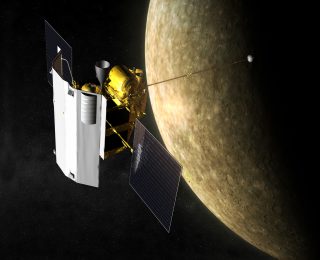
Testing the Limits of Gravity at Mercury

Testing the Limits of Gravity at Mercury

by Avery Schiff | Mar 19, 2018 | Daily Paper Summaries

By studying the precise movements of NASA’s MESSENGER spacecraft around Mercury we can constrain some of the fundamental parameters of general relativity.

« Older Entries
Next Entries »

Loading

Follow our socials

  • Bluesky
  • Facebook
  • Instagram
  • RSS Feed

More Posts About

AAS AGN astronomy astrophysics binary stars black holes cosmology dark matter dwarf galaxies exoplanets galaxies galaxy evolution gravitational waves habitability JWST Kepler Milky Way observations planetary science planet formation protoplanetary disks radio astronomy simulations solar system spectroscopy star formation stars stellar evolution supernovae theory

Posts by Category

  • Accessibility
  • Applications
  • Beyond
  • Book Reviews
  • Career Navigation
  • Classics
  • Climate Change
  • Course Assignments
  • Crossposts
  • Current Events
  • Daily Paper Summaries
  • Game Reviews
  • Guides
  • Historical Astronomy
  • Instrumentation
  • Interviews
  • Outreach
  • Personal Experiences
  • PRJ
  • Quick Notes
  • Satellites
  • Teaching
  • Undergraduate Research

More Astronomy

  • AAS
  • AAS Nova
  • astro-ph
  • AstroBetter
  • APOD

Read Astrobites in Other Languages

  • Astrobitos (Spanish)
  • Astropontos (Portuguese)
  • staryab (Farsi)

Listen to Astrobites

  • astro[sound]bites

Discover More Incredible Science

  • ScienceBites Network
  • RSS

© 2026 Astrobites | All Rights Reserved | Supported by AAS | Designed by Elegant Themes | Powered by WordPress