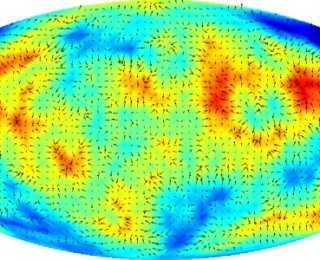
Gravitational Lensing of the CMB
The South Pole Telescope collaboration detects the effects of gravitational lensing on the cosmic microwave background and derives improved constraints on several cosmological parameters.

The South Pole Telescope collaboration detects the effects of gravitational lensing on the cosmic microwave background and derives improved constraints on several cosmological parameters.
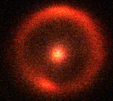
A new dwarf galaxy has been detected a record-breaking 10 billion light years from Earth, using a method based on gravitational lensing. The satellite galaxy is composed mainly of dark matter and is too faint to be observed directly with the current generation of optical telescopes.
Simulations tell us of a web-like Universe but it’s hard to explore this topic observationally because we can’t see dark matter. But the Canada-France-Hawaii Telescope (CFHT) Lensing Survey has made the first large scale map of dark matter. On the first day of AAS #219, the CFHTLenS survey shared their results with us.a
Lensing occurs when the mass of a foreground object distorts and magnifies the light from a background galaxy or quasar, sometimes even creating multiple images. It probably isn’t a stretch to say that the neatest thing about lensing is that you can typically see two to four images of the same galaxy. But something else that’s cool is that these distant background objects are magnified, making it possible to study them in detail when otherwise they might not be seen at all: in this way, gravitational lenses act as natural cosmic telescopes.
Take a look at three different papers written by graduate students on distant galaxies, waves on the Sun, and mapping the Milky Way.
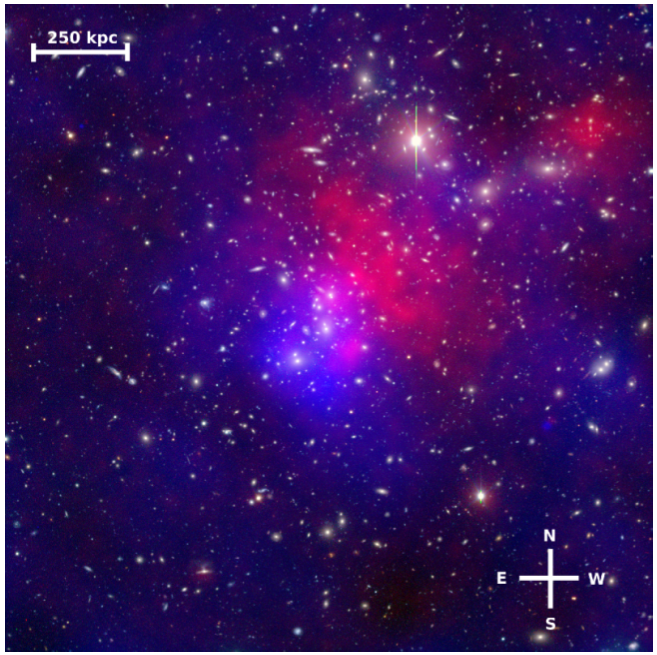
Where can you find ‘ghost’, ‘dark’, ‘stripped’, and ‘bullet’ clusters? The Pandora Cluster, which has become an excellent laboratory for studying the nature of other shady characters in our universe like dark matter.