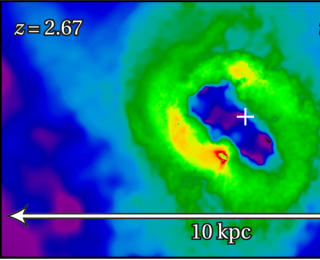
The Top 12 of 2012
What were astronomers reading and talking about in their research last year? Check out figures from the top 12 most-cited astronomy papers from 2012 (so far) and find out what researchers were up to and why!

What were astronomers reading and talking about in their research last year? Check out figures from the top 12 most-cited astronomy papers from 2012 (so far) and find out what researchers were up to and why!
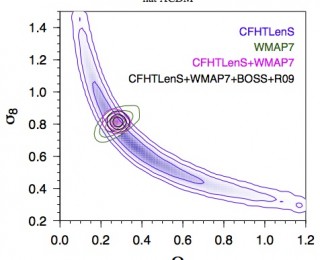
The Canada-France Hawaii Telescope weak gravitational lensing survey (CFHTLens), recently released new results to help constrain our cosmological models. While still in its early stages, weak lensing will ultimately be a powerful tool to discover the nature of the mysterious dark energy.
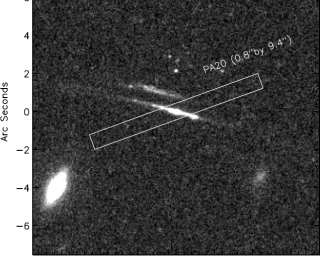
Using massive gravitational lenses can help us study the evolution of galaxies over unprecedented time scales.
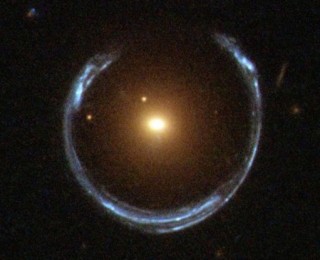
I recently attended a two-week crash course in the “Astrophysical Applications of Gravitational Lensing”. In this post, I overview a few of the ways astronomers employ lensing to study the Universe, from extrasolar planets to distant quasars and large-scale structure.
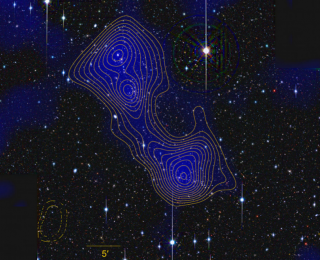
Throughout much of the 20th century, it was an open question in astronomy as to what the universe looked like on the largest observable scales. Were galaxies and galaxy clusters distributed uniformly throughout space, or was there a pattern? Thanks to galaxy surveys we know that, on large scales, the matter distribution of the universe is clumpy instead of smooth. Through these surveys we observe directly the distribution of luminous matter like stars, gas, and galaxies. However, luminous matter comprises only a small fraction of the matter in the universe (17%), the rest is dark matter which interacts via gravity but does not absorb and emit electromagnetic radiation like normal matter. Theoretical simulations of dark matter cosmologies firmly predict that there is a dark matter backbone to the cosmic web, with filaments of dark matter stretching between clusters of galaxies, though has not yet been a robust detection of a dark matter filament, until now.
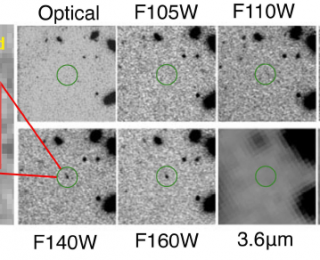
Gravitational lensing has enabled the detection of a galaxy that may be the most distant object ever observed.