
by Elisa Chisari | Jan 15, 2014 | Daily Paper Summaries
There might be more information in the Hubble diagram of supernovae than we first thought. Far away supernovae are subject to gravitational lensing and in the upcoming decades, they could be used to determine how much matter there is in the Universe and how it clusters.
by Elisa Chisari | Dec 11, 2013 | Daily Paper Summaries
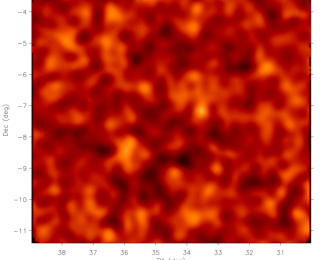
Gravitational lensing is the deflection of the trajectory of a photon by gravity, and it is a natural consequence of the theory of General Relativity. Lensing distorts the shapes and orientations of galaxies and in today’s post, we discuss a new method to reconstruct dark matter maps of our Universe using the position angles of galaxies.
by Chris Faesi | Oct 9, 2013 | Daily Paper Summaries
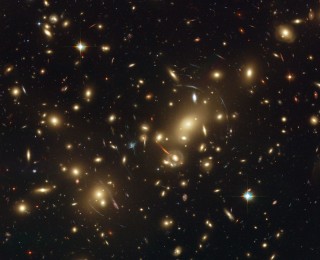
New results from stacked weak lensing measurements of over a hundred thousand galaxies show that, on large scales, light from stars appears to trace the dark matter distribution of the Universe remarkably well.
by Nick Ballering | Sep 9, 2013 | Current Events
NASA is looking for a new mission for the damaged Kepler space telescope. Here are some ideas.
by Erika Nesvold | Apr 4, 2013 | Daily Paper Summaries
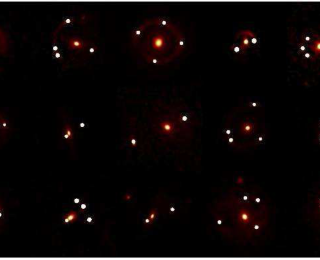
Based on galactic rotation curves, we think that spiral galaxies are embedded in massive dark matter halos. Is the same true for elliptical galaxies? Magain and Chantry use gravitational lensing to measure the mass-to-light ratios in 15 elliptical galaxies, and the results might surprise you!
by Astrobites | Mar 30, 2013 | Daily Paper Summaries
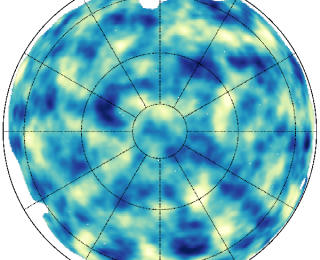
In today’s astrobite, we continue our overview of the papers from the Planck 2013 release. This time, we review papers XVII and XXIII, which discuss weak gravitational lensing of the Cosmic Microwave Background, and the isotropy of the Universe at the time this background radiation was emitted.
