• RSS
  • Submit a Guest Post
  • Undergraduates: Submit your Research!
  • Suggest a Paper Topic!
astrobites
  • About
    • About Astrobites
    • Meet the Authors
    • Statement of Inclusivity
    • Copyright & Permissions
  • Latest Research
    • Daily Paper Summaries
    • Classics
    • Undergrad Research
    • Physical Review Coverage
  • Beyond astro-ph
    • Beyond astro-ph Library
    • Interviews
    • Career Navigation
    • Personal Experiences
    • Current Events
    • Teaching with Astrobites
  • Guides
    • EM Spectrum
    • Galaxies & AGNs
    • Spectroscopy and Spectral Lines
    • Adaptive Optics
    • Gravitational Waves
    • Transient Astronomy
    • Astrophysical Software
    • Graduate School
    • Writing a personal statement for grad apps
    • First Observing Run
    • …More Guides!
Select Page
Putting a ring on it: a newly discovered Einstein ring

Putting a ring on it: a newly discovered Einstein ring

by Joanna Bridge | Jun 17, 2016 | Daily Paper Summaries

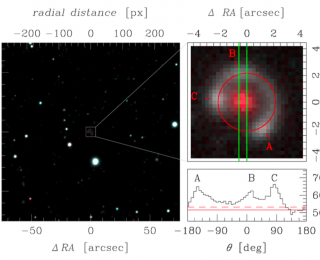
In today’s paper, astronomer’s describe a newly-discovered Einstein ring in the Sculptor constellation.

A Blast from the Past: Forecasting Supernova Refsdal

A Blast from the Past: Forecasting Supernova Refsdal

by Caroline Huang | Feb 17, 2016 | Daily Paper Summaries

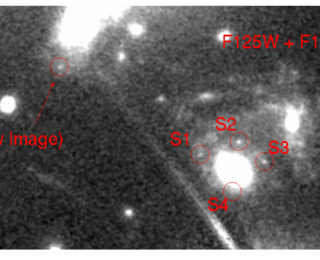
In today’s astrobite, a group of astronomers experiences déjà vu while studying gravitational lensing.
A long-awaited discovery

A long-awaited discovery

by Caroline Huang | Jun 5, 2015 | Daily Paper Summaries

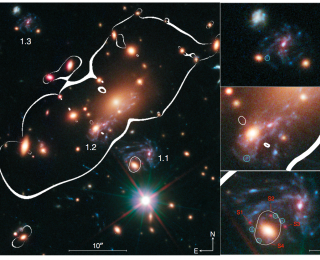
More than 50 years ago, a Norwegian astronomer named Sjur Refsdal outlined an interesting new method for calculating the Hubble constant. Last November, astronomers found the perfect test case.
Weighing galaxy clusters with the CMB

Weighing galaxy clusters with the CMB

by Anson Lam | Dec 29, 2014 | Daily Paper Summaries

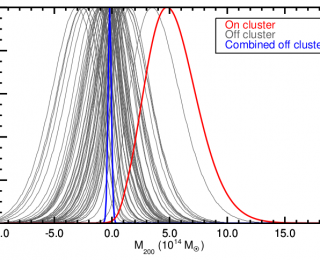
Measuring CMB distortions caused by gravitational lensing is a unique way of estimating galaxy cluster masses.
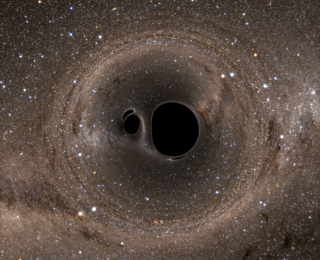
What would a binary black hole merger look like?

What would a binary black hole merger look like?

by Brett Deaton | Nov 4, 2014 | Daily Paper Summaries

What kind of lens is a BBH merger? These authors present the first pictures of light sources lensed by numerical models of BBH mergers.
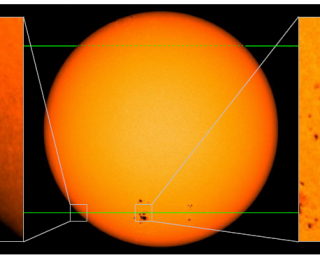
Kepler Discovers a Self-Lensing Star System

Kepler Discovers a Self-Lensing Star System

by Nick Ballering | Apr 28, 2014 | Daily Paper Summaries

Kepler finds the signature of a transiting white dwarf. Instead blocking the light of its companion star, the white dwarf magnifies it, creating a light curve that periodically brightens.

« Older Entries
Next Entries »

Loading

Follow our socials

  • Bluesky
  • Facebook
  • Instagram
  • RSS Feed

More Posts About

AAS AGN astronomy astrophysics binary stars black holes cosmology dark matter dwarf galaxies exoplanets galaxies galaxy evolution gravitational waves habitability JWST Kepler Milky Way observations planetary science planet formation protoplanetary disks radio astronomy simulations solar system spectroscopy star formation stars stellar evolution supernovae theory

Posts by Category

  • Accessibility
  • Applications
  • Beyond
  • Book Reviews
  • Career Navigation
  • Classics
  • Climate Change
  • Course Assignments
  • Crossposts
  • Current Events
  • Daily Paper Summaries
  • Game Reviews
  • Guides
  • Historical Astronomy
  • Instrumentation
  • Interviews
  • Outreach
  • Personal Experiences
  • PRJ
  • Quick Notes
  • Satellites
  • Teaching
  • Undergraduate Research

More Astronomy

  • AAS
  • AAS Nova
  • astro-ph
  • AstroBetter
  • APOD

Read Astrobites in Other Languages

  • Astrobitos (Spanish)
  • Astropontos (Portuguese)
  • staryab (Farsi)

Listen to Astrobites

  • astro[sound]bites

Discover More Incredible Science

  • ScienceBites Network
  • RSS

© 2026 Astrobites | All Rights Reserved | Supported by AAS | Designed by Elegant Themes | Powered by WordPress