• RSS
  • Submit a Guest Post
  • Undergraduates: Submit your Research!
  • Suggest a Paper Topic!
astrobites
  • About
    • About Astrobites
    • Meet the Authors
    • Statement of Inclusivity
    • Copyright & Permissions
  • Latest Research
    • Daily Paper Summaries
    • Classics
    • Undergrad Research
    • Physical Review Coverage
  • Beyond astro-ph
    • Beyond astro-ph Library
    • Interviews
    • Career Navigation
    • Personal Experiences
    • Current Events
    • Teaching with Astrobites
  • Guides
    • EM Spectrum
    • Galaxies & AGNs
    • Spectroscopy and Spectral Lines
    • Adaptive Optics
    • Gravitational Waves
    • Transient Astronomy
    • Astrophysical Software
    • Graduate School
    • Writing a personal statement for grad apps
    • First Observing Run
    • …More Guides!
Select Page
Twinkle, twinkle, highest redshift star; how we wonder what you are!

Twinkle, twinkle, highest redshift star; how we wonder what you are!

by Pratik Gandhi | Apr 7, 2022 | Daily Paper Summaries

What do mythology, Tolkien, and astrophysics have in common?

Gotcha! Finding Isolated Stellar Mass Black Holes

Gotcha! Finding Isolated Stellar Mass Black Holes

by Jana Steuer | Mar 2, 2022 | Daily Paper Summaries

Finding isolated black holes is really tricky, since they are basically invisible. But today’s authors have managed to find one anyways, by using the great multi-tool of gravitational microlensing!

I’m Not Late, You’re Just Early: measuring the Hubble constant using time-delay cosmography

I’m Not Late, You’re Just Early: measuring the Hubble constant using time-delay cosmography

by Abby Lee | Feb 8, 2022 | Daily Paper Summaries

How can we use gravitational lensing to measure the expansion rate of the Universe?
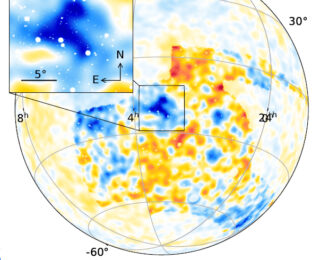
A-void-ing the CMB cold spot

A-void-ing the CMB cold spot

by Laila Linke | Dec 21, 2021 | Daily Paper Summaries

The cold spot is a strange feature in the CMB that has puzzled astronomers for years. Today’s authors use gravitational lensing to find at least a partial cause: A giant supervoid extending 1.8 billion light years!
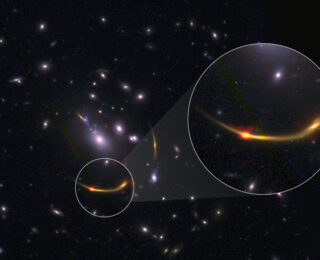
A Requiem for Dead Galaxies

A Requiem for Dead Galaxies

by Olivia Cooper | Sep 30, 2021 | Daily Paper Summaries

Traces of magnified dust offer a requiem to early, dead galaxies that ran out of gas
Peering through the lens of the Milky Way Supermassive Black Hole

Peering through the lens of the Milky Way Supermassive Black Hole

by Sumeet Kulkarni | Sep 24, 2021 | Daily Paper Summaries

One of the most important observations by the next generation of giant telescopes will be made by pointing towards the Supermassive Black Hole at the center of our galaxy.

« Older Entries
Next Entries »

Loading

Follow our socials

  • Bluesky
  • Facebook
  • Instagram
  • RSS Feed

More Posts About

AAS AGN astronomy astrophysics binary stars black holes cosmology dark matter dwarf galaxies exoplanets galaxies galaxy evolution gravitational waves habitability JWST Kepler Milky Way observations planetary science planet formation protoplanetary disks radio astronomy simulations solar system spectroscopy star formation stars stellar evolution supernovae theory

Posts by Category

  • Accessibility
  • Applications
  • Beyond
  • Book Reviews
  • Career Navigation
  • Classics
  • Climate Change
  • Course Assignments
  • Crossposts
  • Current Events
  • Daily Paper Summaries
  • Game Reviews
  • Guides
  • Historical Astronomy
  • Instrumentation
  • Interviews
  • Outreach
  • Personal Experiences
  • PRJ
  • Quick Notes
  • Satellites
  • Teaching
  • Undergraduate Research

More Astronomy

  • AAS
  • AAS Nova
  • astro-ph
  • AstroBetter
  • APOD

Read Astrobites in Other Languages

  • Astrobitos (Spanish)
  • Astropontos (Portuguese)
  • staryab (Farsi)

Listen to Astrobites

  • astro[sound]bites

Discover More Incredible Science

  • ScienceBites Network
  • RSS

© 2026 Astrobites | All Rights Reserved | Supported by AAS | Designed by Elegant Themes | Powered by WordPress