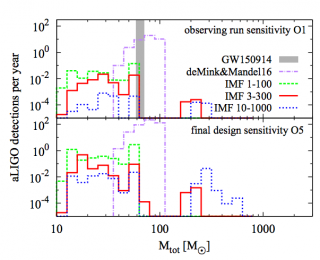
Studying the First Stars with Gravitational Waves
What can aLIGO tell us about the earliest stars? Read today’s astrobite to find out!

What can aLIGO tell us about the earliest stars? Read today’s astrobite to find out!
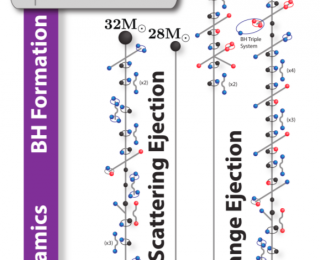
The dense environments in the center of globular clusters lead to an abundance of binary black hole mergers, potentially detectable by LIGO.
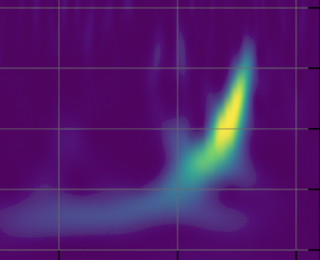
A century after Einstein’s prediction of gravitational waves, LIGO has observed these minuscule ripples in the fabric of spacetime. A new window to the Universe has opened.
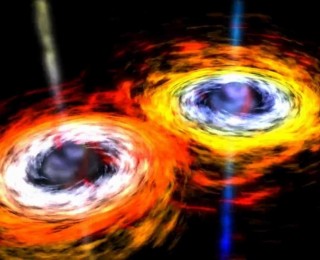
Today’s astrobite is not about disc jockey insects informing us about spacetime. Read on to find out a novel way of detecting electromagnetic counterparts of merging supermassive black holes.
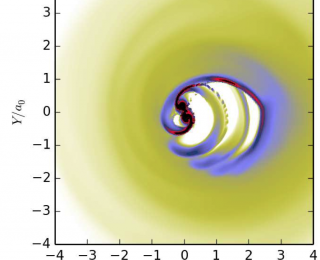
Quasar PSO J334.2028+01.4075 has a very healthy heart rate of 6.7 beats per decade, or once every 542 days. One explanation is that this guy hosts a pair of supermassive black holes. If true, then the astonishing interpretation of this quasar’s heart rate is that its black holes are only a few orbits away from merging!
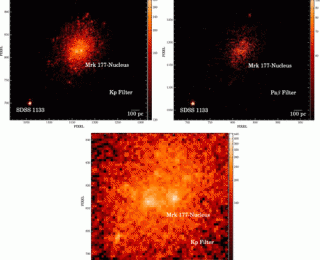
The space between galaxies, long thought to be a near empty void, is now rapidly being revealed to be home to a host of astronomical phenomena. Now astronomers may have added a new type of intergalactic resident to the list: a super-massive black hole, a million times the mass of the Sun, kicked out from its home galaxy.