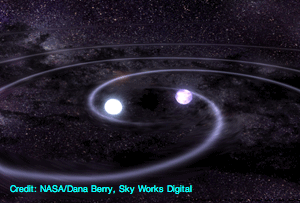
by Elisa Chisari | Oct 20, 2014 | Daily Paper Summaries
In the next few years, gravitational wave detectors are expected to start finding mergers of compact objects. But their resolution is limited to large areas of the sky. Fast galaxy surveys are needed to aid in the task of locating the source more precisely, but how fast can they go?
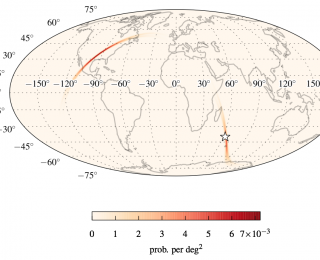
by Brett Deaton | Jun 11, 2014 | Daily Paper Summaries
How quickly will Advanced LIGO/Virgo be able to detect a gravitational wave, and how precisely will they be able to tell their partner electromagnetic telescopes where to point? Today’s authors answer these questions for the most promising and best-understood type of system, binary neutron star mergers. Specifically, they take a realistic look at LIGO/Virgo’s first two online years, including their early sensitivity and expected downtime.
by Elisa Chisari | Jun 2, 2014 | Daily Paper Summaries
Gravitational waves passing through our solar system make the Sun ring like a bell. Can their effect be measured to learn about the violent phenomena that caused them?
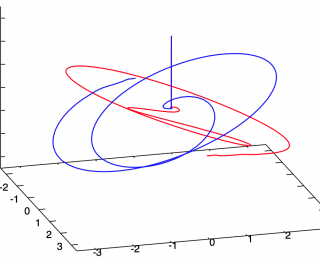
by Brett Deaton | Mar 18, 2014 | Classics
Imagine a spinning skater. She pulls her arms in a little and spins faster. She brings her arms all the way into her chest, and spins really fast, and then bam! she rockets up into the sky. Seven years ago, computer simulations revealed a configuration of two spinning black holes that merged in this way, jumping out of their orbital plane with a velocity of several thousand km/s. Not only is this weird, it’s also important. We know that large galaxies host supermassive black holes at their centers. We also know that galaxies merge, presumably introducing their black holes to one another. If the newly formed black hole were to exit the galaxy entirely, it could carry its accretion disk with it, and be observable as a displaced core.
by Brett Deaton | Jan 22, 2014 | Daily Paper Summaries
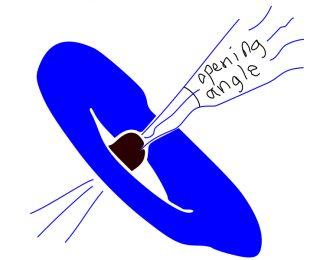
Null data are still data! Chen & Holz use a lack of detections to place a lower limit on the beaming angle of SGRBs.
by Elisa Chisari | Jun 26, 2013 | Daily Paper Summaries
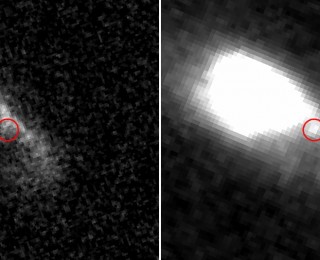
Short gamma-ray bursts, extremely energetic explosions in the Universe, might be caused by the merger of two compact objects. In the two papers we discuss today, the authors test this scenario by looking for light emitted still a few days after the explosion.
