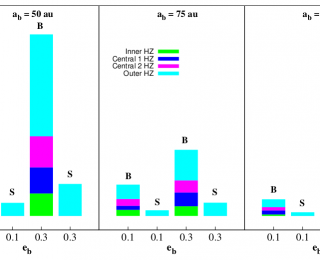
Flinging Asteroids into the Habitable Zone
Planets in binary star systems can receive a sizable amount of water from asteroids getting perturbed out of their orbits

Planets in binary star systems can receive a sizable amount of water from asteroids getting perturbed out of their orbits
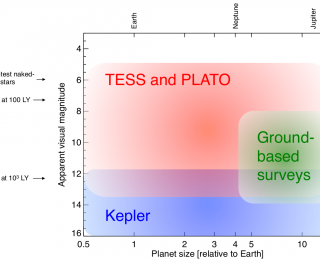
The exoplanet hunt is on. The stakes are high. What will our next-generation telescopes find?

Earth’s oceans may have originated mainly from accreted impactors. But do planets in other systems experience the same water delivery mechanism? Or do they even get more water than our world? Find out why you would want to think about this and what the consequences might be.
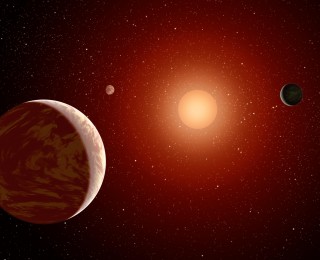
Could the properties of an M-dwarf that might make it inhospitable also give it transformative powers? Could the star’s gravity and violence strip away a planet’s thick atmosphere, or envelope, to reveal a habitable core?
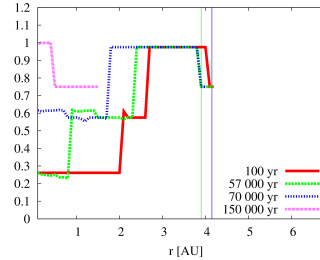
The recent discoveries of alien worlds seemingly rich in carbon reveal a lot of diverse information about the history and further evolutionary paths of exoplanets. However, a correct physical understanding of the investigated systems is crucial for getting the most out of incoming data and is an area of very active research. Therefore, the theoretical modeling of exoplanetary systems must be advanced to a state which includes the long-term evolution of the distribution of detectable molecular species in the planet forming environment.
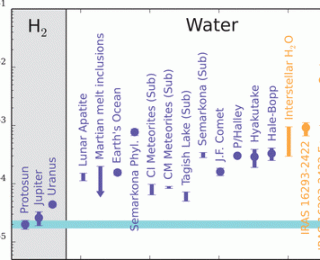
Water is essential for life, but where does it come from? Read on and learn that a significant amount is inherited from the interstellar medium.