by Elizabeth Lovegrove | Mar 5, 2012 | Guides
I like Cracked. You probably do too. But like that old adage that every newspaper story is true except for the ones for which you happen to have firsthand knowledge, I found their recent article on 6 Real Planets That Put Science Fiction To Shame to be . . . lacking. Not lacking in funny, or facts, but lacking in my favorite planets, and some of the weirdest specimens the universe has yet to offer up. So, without further ado, here are 6 more real planets (plus a bonus) that any sci-fi editor would have rejected as “too out there” just a few decades ago.
by Lauren Weiss | Feb 29, 2012 | Daily Paper Summaries
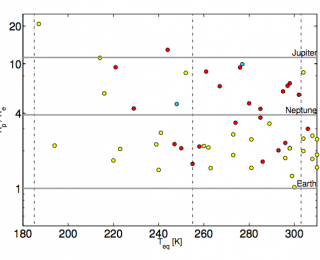
Of Kepler’s 2,321 planet candidates, many are in the “habitable zone.”
by Lauren Weiss | Feb 28, 2012 | Current Events, Guides
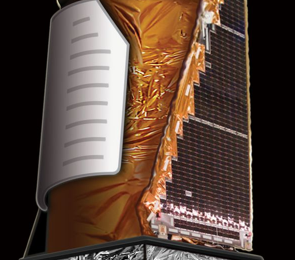
If Kepler does not obtain additional financial support, it will “close its eyes forever.” – Natalie Batalha.
by Shannon Hall | Feb 12, 2012 | Daily Paper Summaries
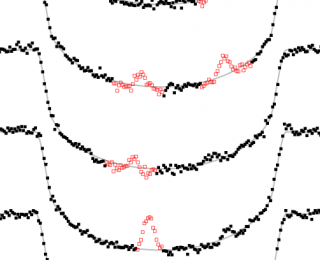
This paper discusses the observed anomalies caused by starspot occultations due to transiting exoplanets. They are useful in determining the obliquity of the star with respect to the orbital plane of the transiting planet.
by Caroline Morley | Feb 1, 2012 | Daily Paper Summaries
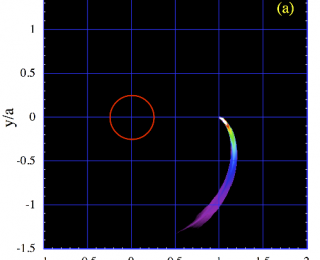
A very small rocky planet—close to the size of Mercury—is evaporating as it orbits the host star. The putative planet orbits the star in less than 16 hours, so the planet’s surface is highly irradiated. The planet would actually be hot enough to vaporize rocky material at the surface, which could escape the gravitational pull of the planet and form a comet-like tail trailing the orbit.
by Elisabeth Newton | Jan 12, 2012 | Current Events
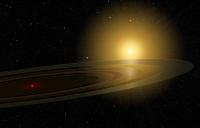
Today at the “Extraordinary Exoplanets” press release (which could righty be called “Extreme Exoplanets”), there were three very interesting and very distinct discoveries announced. William Welsh announced Kepler-34b and Kepler-35b, two new circumbinary planets from the Kepler team. John Johnson and Phil Muirhead presented three new sub-Earth sized planets orbiting an M dwarf. Finally, Erik Mamajek showed us the first ever transit of an extrasolar “ring” system.
