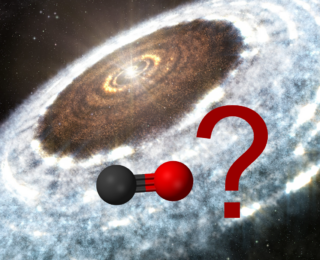
Diffusion and depletion of carbon monoxide in disks
Where is the missing carbon monoxide in protoplanetary disks? Today’s paper suggests that it might have something to do with turbulent mixing in disks as well as the physics of condensation.

Where is the missing carbon monoxide in protoplanetary disks? Today’s paper suggests that it might have something to do with turbulent mixing in disks as well as the physics of condensation.

How do supermassive black holes get to be so supermassive? Today’s authors explore how we might be able to answer that question with the SKA pulsar timing array!
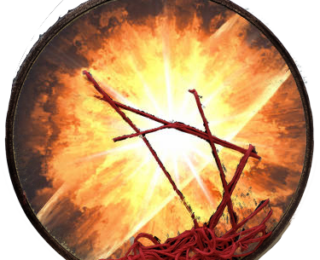
The authors of today’s paper simulate in impeccable detail the first few minutes of a binary-driven hypernova (the brighter cousin of a supernova) while paying close attention to how the dynamics affect the companion neutron star. They predict several observables from the process, including what has been observed in the gamma ray burst event GRB 190829A.
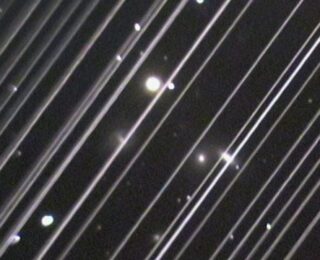
Satellite constellations are changing ground-based astronomy with every new launch. How can we quantify their impacts, and can anything be done to mitigate them?
Adding galaxies to dark matter simulations might be easier than you thought – today’s authors present a new method to generate synthetic data from relatively low-resolution DM simulations!
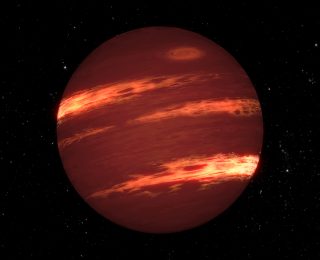
Brown Dwarfs can have swirling cloudy atmospheres just like their planetary cousins, but, as observed from the ground, the subject of today’s bite isn’t quite so variable after all.