by Shannon Hall | Mar 10, 2013 | Daily Paper Summaries
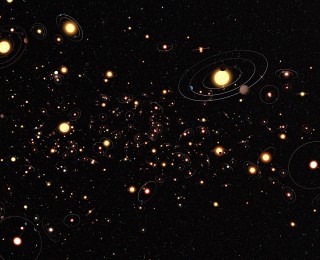
It is likely that all exoplanet systems have 4 or more planets orbiting a single star. If we look at the number of specific orbital period ratios for both high multiplicity systems (4 or more transiting planets) and low multiplicity systems (2 transiting planets) we may verify this. We may also make statements about the formation and evolution of planetary systems as well as search for any additional planets.
by Betsy Mills | Feb 20, 2013 | Daily Paper Summaries
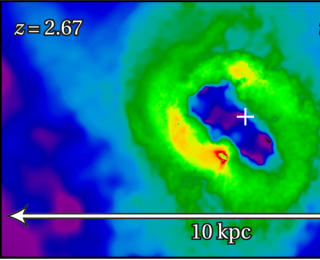
What were astronomers reading and talking about in their research last year? Check out figures from the top 12 most-cited astronomy papers from 2012 (so far) and find out what researchers were up to and why!
by Caroline Morley | Feb 14, 2013 | Daily Paper Summaries
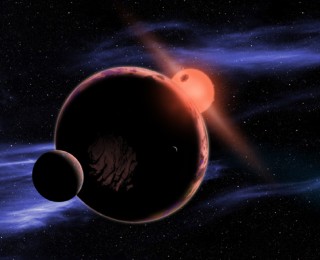
The census of planets for smaller stars—M dwarfs—is now basically complete. In this paper, Courtney Dressing and Dave Charbonneau use this M dwarf advantage to determine the occurrence rate of small planets around M dwarfs.
by Ben Montet | Feb 8, 2013 | Daily Paper Summaries
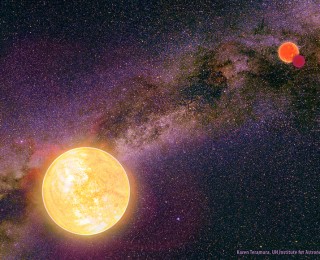
By looking for variations in the observed periods for eclipsing binary stars, astronomers have found evidence that a sizable fraction of these systems are actually systems of three or more stars.
by Nick Hand | Jan 26, 2013 | Daily Paper Summaries
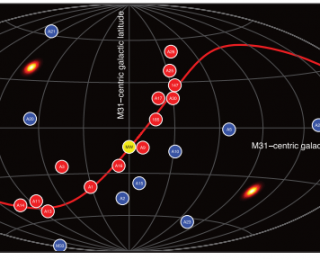
The authors have identified several satellite galaxies confined to a plane in their orbits around our nearest neighbor, the Andromeda Galaxy. Such a planar structure is perhaps at odds with our current understanding of galaxy formation.
by Josh Fuchs | Jan 24, 2013 | Daily Paper Summaries
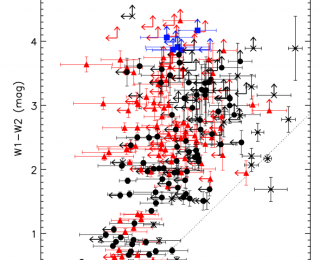
With the addition of these 87 new T dwarfs, WISE has now tripled the number of known T dwarfs with spectral type later than T5.
