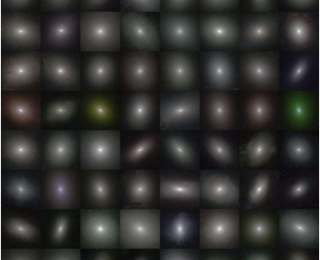
Digging up “red nuggets” in local elliptical galaxies
Huang et al. dig up evidence that distant “red nugget” galaxies grew into the massive ellipticals we see today by consuming smaller, gas-poor galaxies.

Huang et al. dig up evidence that distant “red nugget” galaxies grew into the massive ellipticals we see today by consuming smaller, gas-poor galaxies.
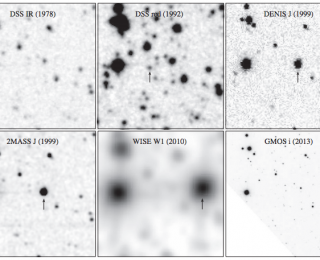
A new brown dwarf system has been discovered only 2 parsec away; Gillon et al. analyze its light curve to study clouds on the surfaces of these stars.

Spectroscopy with Herschel can probe the dust in the heart of protoplanetary disks through the 69 micron feature of forsterite. Examining these features in detail reveals that the dust grains are small, iron poor, and confined to narrow rings.
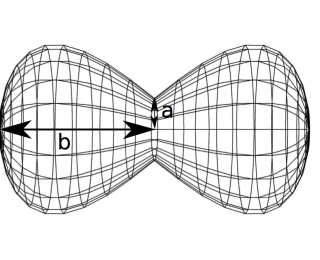
Novae are thermonuclear explosions that occur on the surface of a white dwarf following the accretion of matter from a nearby companion star. The authors seek to understand the geometry and velocity of the ejected material.
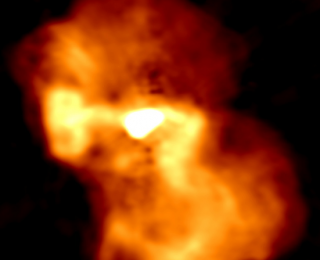
Check out these cool new results from LOFAR which is boldly going to some of the longest wavelengths astronomers have ever observed! An active galaxy has a less active past than we might expect, pulsating neutron stars are behaving strangely, and even at wavelengths as long as meters, there are still spectral lines from extremely low-energy atomic transitions.
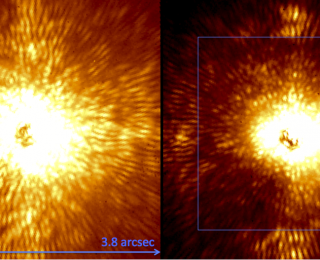
Two years ago this month, I wrote my very first astrobite about the puzzlingly cloudy atmosphere of the outermost planet, HR 8799b; today I’m revisiting the system and looking at a recent paper which measured spectra of not just one planet, but the entire planetary system. This is the first comparative spectroscopic study of any multi-planet system (other than our own Solar System of course).