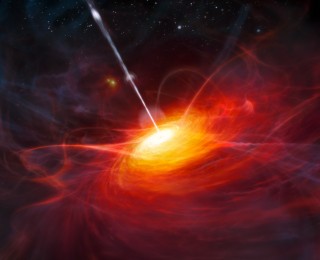
Dust-Rich Quasars at z~1.5
How does AGN activity influence star formation in active galaxies? Dai et al. combine multi-wavelength observations of 32 quasars to bring us closer to the answer.

How does AGN activity influence star formation in active galaxies? Dai et al. combine multi-wavelength observations of 32 quasars to bring us closer to the answer.
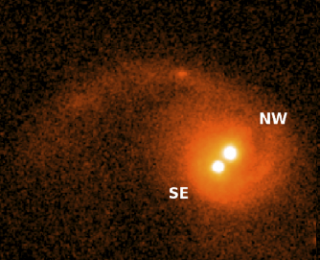
It has long been known that galaxies can merge; thus, we should expect their central supermassive black holes to interact as well. However, our ability to study this is limited as most mergers happen in the distant universe. The exceptional nearby source CID-42 can be explained by a recent binary or triple supermassive black hole interaction, giving astronomers a rare chance to witness the repercussions of such an event.
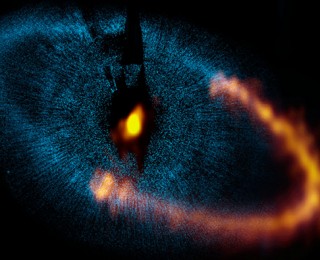
The first science results from ALMA include remarkable images of the dust ring encircling the notorious Fomalhaut. Modeling of the ring’s morphology suggests the existence of two planets, each with a mass comparable to the mass of the Earth.
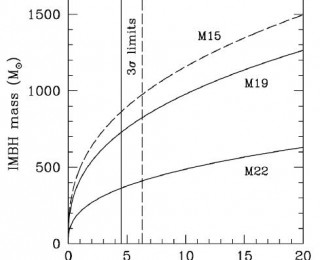
Strader et al. search for the elusive intermediate mass black holes in globular clusters.
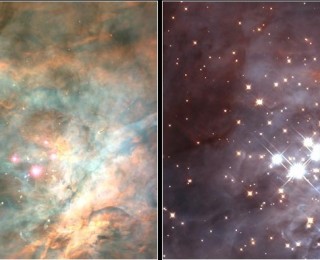
This paper demonstrates a brand new method of calculating Hubble’s Constant using the luminosity of HII galaxies.
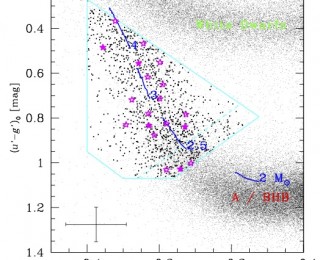
Five new hypervelocity stars have been discovered in the outer regions of the Milky Way. In this paper, the authors discuss what these stars are, how they got so far away, and what their distribution implies about the center of our galaxy.