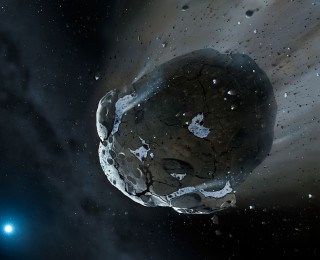
by Tim Lichtenberg | Mar 6, 2015 | Daily Paper Summaries
Earth’s oceans may have originated mainly from accreted impactors. But do planets in other systems experience the same water delivery mechanism? Or do they even get more water than our world? Find out why you would want to think about this and what the consequences might be.
by Jaime Green | Mar 4, 2015 | Daily Paper Summaries
Hot Jupiters are weird and lonely. Is gravitational perturbation to blame?
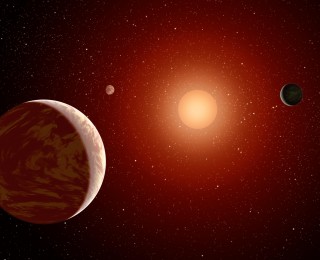
by Jaime Green | Feb 11, 2015 | Daily Paper Summaries
Could the properties of an M-dwarf that might make it inhospitable also give it transformative powers? Could the star’s gravity and violence strip away a planet’s thick atmosphere, or envelope, to reveal a habitable core?
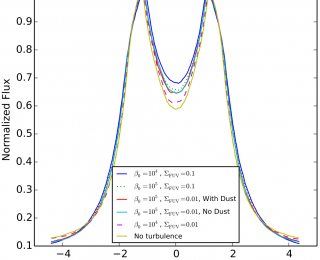
by Tim Lichtenberg | Feb 6, 2015 | Daily Paper Summaries
Why do planetary disks fade away so fast? A leading candidate as villain in this story is turbulence. Using the combined strengths of sophisticated theoretical models and observations, we might be able to find out if this is true!
by Tim Lichtenberg | Jan 2, 2015 | Daily Paper Summaries
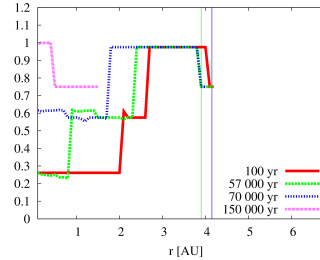
The recent discoveries of alien worlds seemingly rich in carbon reveal a lot of diverse information about the history and further evolutionary paths of exoplanets. However, a correct physical understanding of the investigated systems is crucial for getting the most out of incoming data and is an area of very active research. Therefore, the theoretical modeling of exoplanetary systems must be advanced to a state which includes the long-term evolution of the distribution of detectable molecular species in the planet forming environment.
by Ruth Angus | Jan 1, 2015 | Daily Paper Summaries
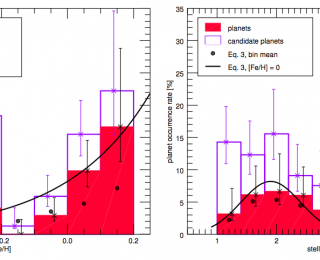
Are more massive stars more likely to have planets? Read on to find out…
