by Tim Lichtenberg | Jun 26, 2015 | Daily Paper Summaries
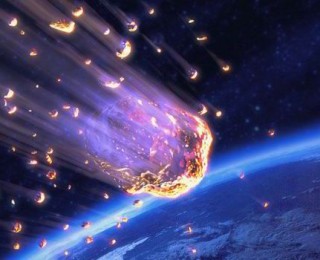
Amino acids were possibly brought to Earth by meteorite impacts, which contaminated the young environment with organic compounds. However, where and how did these most basic ingredients of life form in the first place?
by Anson Lam | Jun 23, 2015 | Daily Paper Summaries
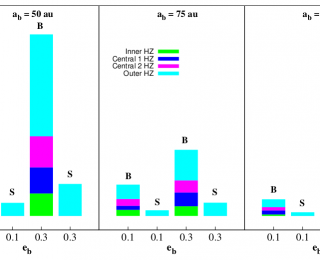
Planets in binary star systems can receive a sizable amount of water from asteroids getting perturbed out of their orbits
by Tim Lichtenberg | May 29, 2015 | Daily Paper Summaries
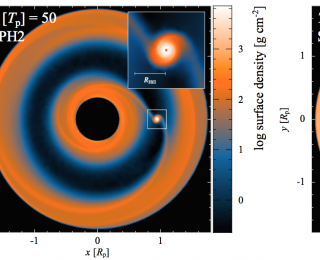
Often science is a competition. Being first is sometimes important to get the well deserved credit for your work. Circumplanetary disks are currently a topic, in which you can still be first, since none has been detected so far. But is the current generation of telescopes already good enough to do that?
by Ben Cook | May 13, 2015 | Daily Paper Summaries
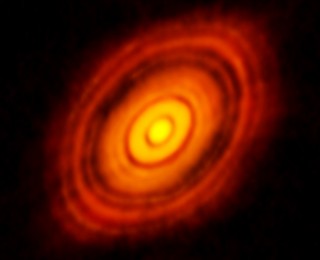
The authors of today’s paper show that the locations of the protoplanetary gaps in HL Tau are to be expected from the condensation points of common ices in the disk.
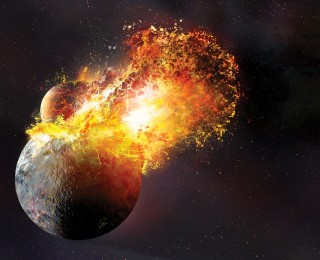
by Michael Zevin | Apr 8, 2015 | Daily Paper Summaries
4.5 billion years ago, a Mars-sized body was believed to have impacted a young Earth, and this planetesimal’s obliterated remains coalesced into what is now our Moon. However, certain striking similarities between the Earth and Moon question the likelihood of this event. Two recent papers investigated the giant impact scenario, only to come to opposite conclusions. Read on to hear more about this lunar enigma.

by Michael Küffmeier | Apr 3, 2015 | Classics, Daily Paper Summaries
Planets seem to occur all over the place in the universe. However, it is still unknown how they form. The growth of objects larger than meter size is difficult because objects of this size quickly fall into the central star. This Astrobite gives a small overview of the meter-size barrier as found by Stuart J. Weidenschilling in 1977.
