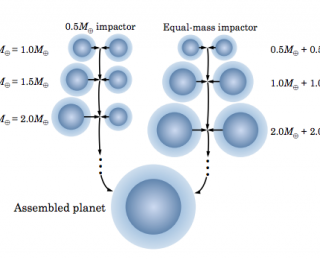
How a Super-Earth Gets Its Atmosphere (or At Least Where It Doesn’t)
Super-Earths could form close-in to their stars… but what about their atmospheres?

Super-Earths could form close-in to their stars… but what about their atmospheres?
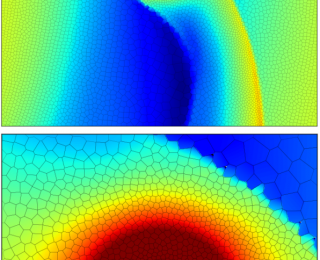
Only the combined effort of observational and theoretical methods can really bring us to a more thorough understanding of the Universe throughout all spatial scales. The authors of today’s paper use and adapt the moving-mesh fluid mechanics code AREPO to function with protoplanetary disks and test its imprint on the potential of planets to open up gaps in the surrounding gas.

Chondrules are among the oldest components of the solar system and give insight in the solar system’s earliest phase. But how are they formed? In shocks? That seems to be at least difficult.
Over the past decade the study of planetary debris at white dwarfs has become an increasingly exciting area. Observations of this debris have allowed us to make unique discoveries about the chemical composition of extrasolar rocky planets, as well as revealing the endpoints of the evolution of planetary systems very similar to our own…
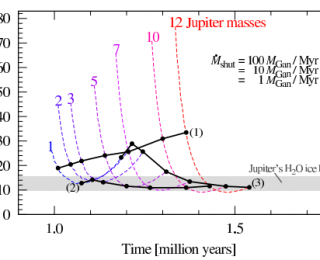
Those of us who love astrobiology get really worked up about the lack of Earth-sized exoplanets found at Earth-like distances from their stars. All we want, we who hope for lots of extraterrestrial life, is a bunch of Earth-like planets doing Earth-like things so we can feel better about the odds for lots of Earth-like life in the universe.
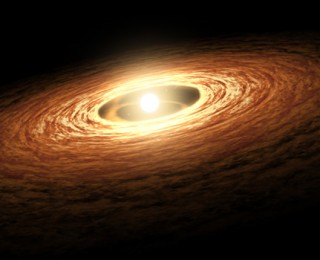
There does not seem to be enough mass in protoplanetary disks to build the planetary systems we’ve detected. The solution: planet formation might start sooner than previously thought.