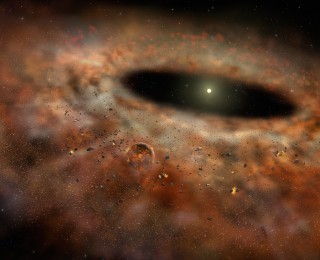
A Cosmic Vanishing Act
The authors report on a young, Sun-like star with a debris disk of dust and larger rocks that has had the dust particles mysteriously vanish from the disk in a span of less than two years.

The authors report on a young, Sun-like star with a debris disk of dust and larger rocks that has had the dust particles mysteriously vanish from the disk in a span of less than two years.
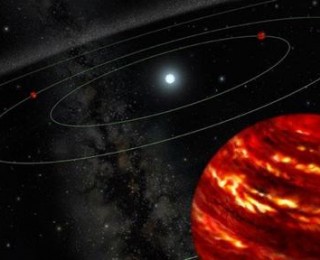
What fraction of massive stars host gas giants? Vigan et al. observe a sample of A and F stars to find out.
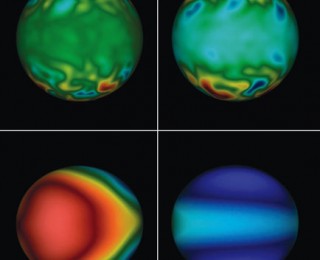
“Characterizing atmospheres beyond the Solar System is an endeavor no longer confined to the realm of science fiction.”
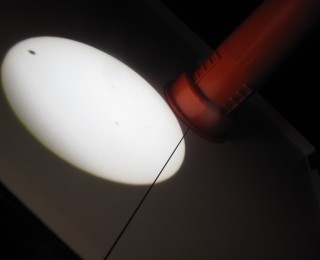
Tuesday was was the second of this century’s pair of transits of Venus; I didn’t catch the 2004 transit, but I was fortunate to have a prime view of Tuesday’s. Like many others, I turned my eyes (safely behind sun filters) towards the Sun and the little black dot traversing its surface. I asked the Astrobites authors to share their experiences with us.
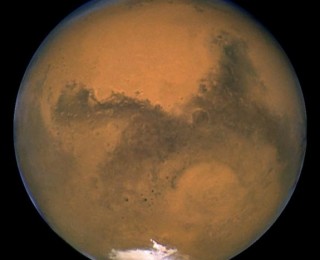
Mars is observed to have sedimentary rocks, which provide proof that liquid water once existed on the Martian surface. However, the surface of Mars would have been too cold to have permanent rivers and lakes; the authors of this paper suggest seasonal snowmelt could create enough liquid water to form these rocks.
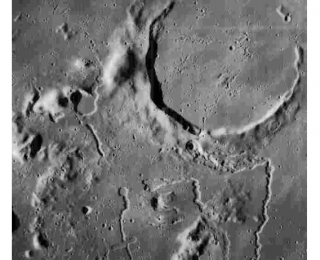
A brief history of scientists’ views on water and the Moon.