by Elisabeth Newton | May 9, 2012 | Daily Paper Summaries
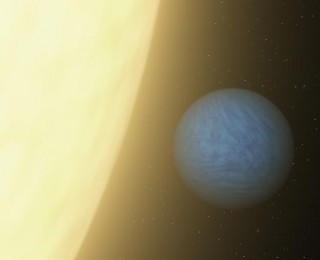
Last year, I reported on how the mystery of 55 Cancri e was resolved. In this Letter, Demory et al. observe the secondary eclipses of 55 Cnc e (when the planet passes behind the star), allowing them to determine the planet’s temperature. At 3,800 degrees Fahrenheit: this super Earth is not looking like a good vacation spot. They are also able to explore possible compositions for the planet.
by Caroline Morley | May 3, 2012 | Daily Paper Summaries
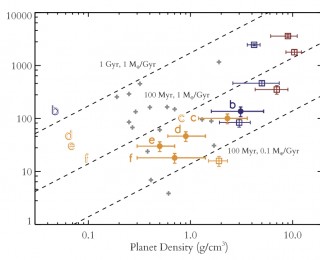
To characterize the newly-discovered population of small planets, this team from UC Santa Cruz investigated how planets lose mass over their lifetimes, and determined how this loss will affect planet populations. This paper suggests that we can understand the population of small planets using mass loss models, and we make predictions using these models for the masses of irradiated super-Earths.
by Elizabeth Lovegrove | Apr 29, 2012 | Current Events, Guides
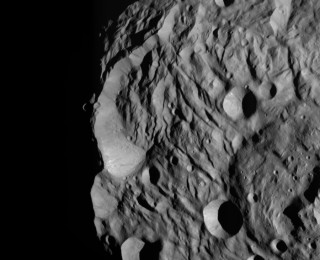
A coalition of willing billionaires, spaceflight professionals, and scientific advisors under the banner of Planetary Resources have announced their intention to go out there and mine themselves some asteroids. Are they serious? What’s going to happen? What does it mean for astronomers and planetary scientists? What contributions will the scientific community make, and what data do we stand to gain?
by Courtney Dressing | Apr 26, 2012 | Daily Paper Summaries
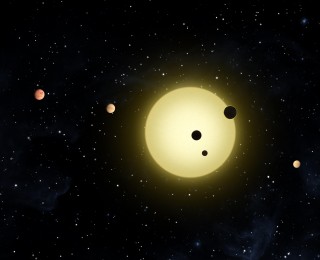
Many Super-Earths appear to be less dense than the Earth. How do such planets form? Could a rocky Super-Earth accrete a hydrogen-helium atmosphere in-situ?
by Courtney Dressing | Mar 29, 2012 | Daily Paper Summaries
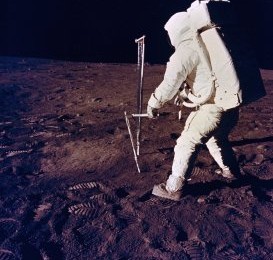
Are robotic missions really more efficient than human space exploration? Ian Crawford explains why planetary astronomers should support human space exploration.
by Elisabeth Newton | Mar 28, 2012 | Daily Paper Summaries
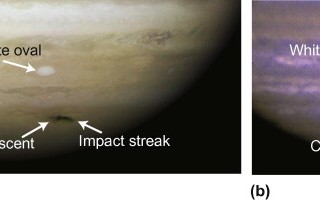
The impact of comet Shoemaker-Levy 9 was a remarkable event: in 1994, a comet, torn into pieces during a close approach with Jupiter two years prior, crashed into Jupiter. It was the first collision between two solar system bodies to ever be observed, and the effects on Jupiter’s atmosphere (see the figure below) were visible for months. At the time, Harrington et al. (2004) predicted that it would be hundreds of years before such an event occurred again. But two and a half years ago, another object collided with Jupiter. No one witnessed the collision, but amateur astronomer A. Wesley noticed a dark streak with properties closely matching those seen after the impact of SL-9. Because of these similarities, it is believed that this feature was the result of an impact.
