by Lauren Weiss | Jan 27, 2012 | Daily Paper Summaries
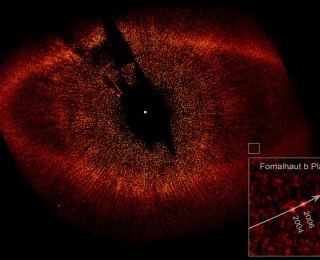
When new evidence disagrees with our previous understanding, we must reinterpret everything.
by Courtney Dressing | Jan 19, 2012 | Daily Paper Summaries
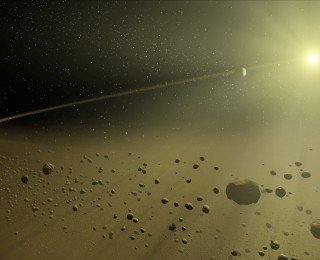
Where should astronomers look to find terrestrial planets? Raymond et al. argue that debris disks are signposts of terrestrial planet formation.
by Elisabeth Newton | Jan 18, 2012 | Daily Paper Summaries
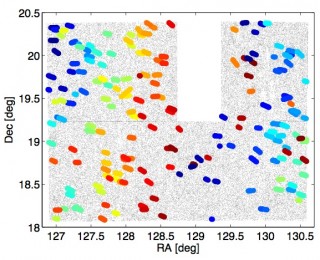
Title: Asteroid rotation periods from the Palomar Transient Factory survey Authors: D. Polishook, E. O. Ofek, A. Waszczak, S. R. Kulkarni, A. Gal-Yam, O. Aharonson, R. Laher, J. Surace, C. Klein, J. Bloom, N. Brosch, D. Prialnik, C. Grillmair et al. First Author’s Institution: Benoziyo Center for Astrophysics, Weizmann Institute of Science, IsraelDetermination of the rotation periods of asteroids has a number of applications. When considering an asteroid individually, it can help one to understand the physical properties of an individual asteroid, including its shape and whether or not it’s a binary. In a statistical sense, the rotations of the entire population of asteroids can help one to understand the physical processes that govern asteroid rotation. The two mechanisms that influence an asteroid’s rotatation are collisions and something called the YORP effect, in which photons from the Sun are actually able to accelerate asteroids through absorption and re-emission. There’s a nice discussion of this type of science which includes a description of the YORP effect in this Cornell press release, while this Discovery news story reports on the first direct detection of the YORP effect (which combines the initials of four different people).*Currently there are 3,700 asteroids with measured rotation periods; using the Palomar Transient Factory, these authors aim to eventually measure rotation periods for 10,000 asteroids. (PTF also finds supernovae, see for example this discovery). In this paper, Polishook et al. report on the identification of 624 asteroids in the PTF survey, 20% of which are new discoveries, and 88 new rotation period measurements. All of the asteroids identified belong to the main asteroid belt. The smallest asteroids...
by Elisabeth Newton | Jan 12, 2012 | Current Events
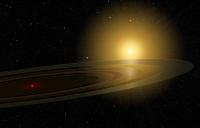
Today at the “Extraordinary Exoplanets” press release (which could righty be called “Extreme Exoplanets”), there were three very interesting and very distinct discoveries announced. William Welsh announced Kepler-34b and Kepler-35b, two new circumbinary planets from the Kepler team. John Johnson and Phil Muirhead presented three new sub-Earth sized planets orbiting an M dwarf. Finally, Erik Mamajek showed us the first ever transit of an extrasolar “ring” system.
by Courtney Dressing | Jan 6, 2012 | Daily Paper Summaries
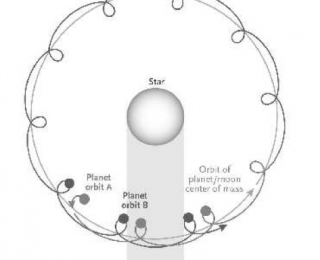
Moons in other solar systems are common in science fiction. Are they common in the universe as well? Kipping et al. are using Kepler data to find out.
by Courtney Dressing | Dec 14, 2011 | Daily Paper Summaries
Today, Mercury rotates only three times in two Mercury years. How did the planet get to this state? Was Mercury tidally locked in the past?
