by Elisabeth Newton | Dec 11, 2012 | Daily Paper Summaries
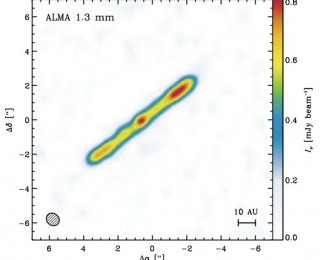
I’ve got pretty bad eyesight. If I take off my glasses and look at the flowers on my window sill, they look like a fuzzy yellow blob. But with glasses, the petals and the patterns cast on them come into focus. This is how I felt when looking at the new observations of the debris disk around AU Mic. Putting on our ALMA glasses, the fuzzy debris disk around AU Mic is sharpening into something surprisingly consistent with our own Solar System.
by Courtney Dressing | Dec 7, 2012 | Daily Paper Summaries
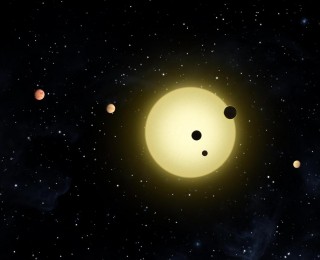
Can we infer the presence of multiple planets by monitoring how a star’s brightness changes outside of planetary transit?
by Courtney Dressing | Nov 8, 2012 | Daily Paper Summaries
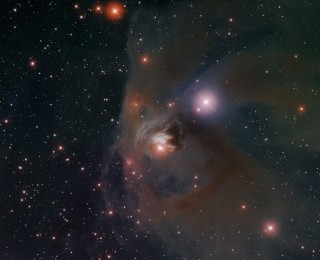
How long does planetary migration take? Crockett et al. look for the answer by searching for hot Jupiters around extremely young stars.
by Courtney Dressing | Oct 26, 2012 | Daily Paper Summaries
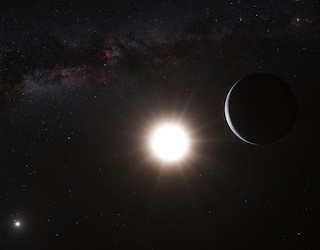
Astronomers recently announced the discovery of a short period Earth-mass planet in the Alpha Centauri system. Could Earth-mass planets exist in the habitable zones of binary stars?
by Courtney Dressing | Aug 17, 2012 | Daily Paper Summaries
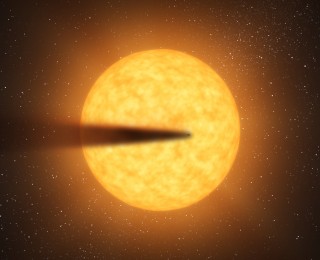
Could the strange transit-light signature seen in the light curve of a Kepler target be caused by a transiting dust cloud?
by Courtney Dressing | Aug 2, 2012 | Daily Paper Summaries
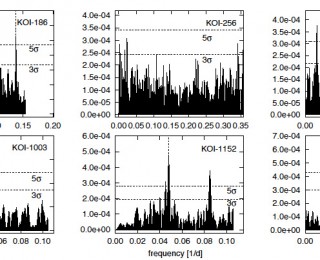
The leading theory is that hot Jupiters tend to occur in single planet systems, but Szabo et al. find evidence that some hot Jupiters might reside in multi-planet systems. Are hot Jupiters actually lonely?
