
• RSS
  • Submit a Guest Post
  • Undergraduates: Submit your Research!
  • Suggest a Paper Topic!
astrobites
  • About
    • About Astrobites
    • Meet the Authors
    • Statement of Inclusivity
    • Copyright & Permissions
  • Latest Research
    • Daily Paper Summaries
    • Classics
    • Undergrad Research
    • Physical Review Coverage
  • Beyond astro-ph
    • Beyond astro-ph Library
    • Interviews
    • Career Navigation
    • Personal Experiences
    • Current Events
    • Teaching with Astrobites
  • Guides
    • EM Spectrum
    • Galaxies & AGNs
    • Spectroscopy and Spectral Lines
    • Adaptive Optics
    • Gravitational Waves
    • Transient Astronomy
    • Astrophysical Software
    • Graduate School
    • Writing a personal statement for grad apps
    • First Observing Run
    • …More Guides!
Select Page

What We Don’t Know About Protoplanetary Disks

by Lauren Sgro | Mar 26, 2019 | Daily Paper Summaries

Protoplanetary disks may be the birth place of planets, but they also throw astronomers for a loop in today’s paper.
A protoplanetary disk on its side

A protoplanetary disk on its side

by Samuel Factor | Feb 11, 2019 | Daily Paper Summaries

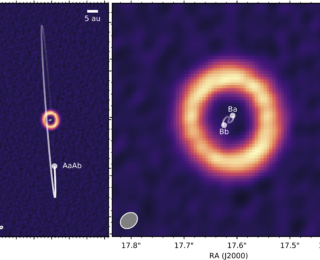
What does a disk around a binary star look like? One possibility, recently observed around a young star for the first time, is that it is flipped on its side—its rotation is perpendicular to the orbit of the binary system!

Meet the AAS Keynote Speakers: Dr. Catherine Espaillat

by Vatsal Panwar | Jan 10, 2019 | Career Navigation, Current Events

How do the protoplanetary disks around young pre-main sequence stars evolve into planetary systems? Come attend Dr. Catherine Espaillat’s plenary talk “From Disks to Planets: Observing Planet Formation in Disks Around Young Stars” at #AAS233 to know more!

Planetary Cookie Doughs at High Angular Resolution

Planetary Cookie Doughs at High Angular Resolution

by Vatsal Panwar | Dec 27, 2018 | Daily Paper Summaries

On the third day of Christmas the ALMA gave to me, 20 highly resolved protoplanetary disks!

How can you tell if a young planet is migrating?

How can you tell if a young planet is migrating?

by Michael Hammer | Nov 15, 2018 | Daily Paper Summaries

It is difficult to tell if planets embedded in their natal protoplanetary disks are migrating closer to their stars. The authors of today’s paper devise a new observational signature to figure that out.

How can planets be heavier than the disks that formed them?

How can planets be heavier than the disks that formed them?

by Emma Foxell | Oct 15, 2018 | Daily Paper Summaries

Planets form from protoplanetary disks. How they can be heavier on average than the disks is questioning our theories of planet formation.

« Older Entries
Next Entries »

Loading

Follow our socials

  • Bluesky
  • Facebook
  • Instagram
  • RSS Feed

More Posts About

AAS AGN astronomy astrophysics binary stars black holes cosmology dark matter dwarf galaxies exoplanets galaxies galaxy evolution gravitational waves habitability JWST Kepler Milky Way observations planetary science planet formation protoplanetary disks radio astronomy simulations solar system spectroscopy star formation stars stellar evolution supernovae theory

Posts by Category

  • Accessibility
  • Applications
  • Beyond
  • Book Reviews
  • Career Navigation
  • Classics
  • Climate Change
  • Course Assignments
  • Crossposts
  • Current Events
  • Daily Paper Summaries
  • Game Reviews
  • Guides
  • Historical Astronomy
  • Instrumentation
  • Interviews
  • Outreach
  • Personal Experiences
  • PRJ
  • Quick Notes
  • Satellites
  • Teaching
  • Undergraduate Research

More Astronomy

  • AAS
  • AAS Nova
  • astro-ph
  • AstroBetter
  • APOD

Read Astrobites in Other Languages

  • Astrobitos (Spanish)
  • Astropontos (Portuguese)
  • staryab (Farsi)

Listen to Astrobites

  • astro[sound]bites

Discover More Incredible Science

  • ScienceBites Network
  • RSS

© 2026 Astrobites | All Rights Reserved | Supported by AAS | Designed by Elegant Themes | Powered by WordPress
