• RSS
  • Submit a Guest Post
  • Undergraduates: Submit your Research!
  • Suggest a Paper Topic!
astrobites
  • About
    • About Astrobites
    • Meet the Authors
    • Statement of Inclusivity
    • Copyright & Permissions
  • Latest Research
    • Daily Paper Summaries
    • Classics
    • Undergrad Research
    • Physical Review Coverage
  • Beyond astro-ph
    • Beyond astro-ph Library
    • Interviews
    • Career Navigation
    • Personal Experiences
    • Current Events
    • Teaching with Astrobites
  • Guides
    • EM Spectrum
    • Galaxies & AGNs
    • Spectroscopy and Spectral Lines
    • Adaptive Optics
    • Gravitational Waves
    • Transient Astronomy
    • Astrophysical Software
    • Graduate School
    • Writing a personal statement for grad apps
    • First Observing Run
    • …More Guides!
Select Page
Protoplanetary Disks might be More Turbulent

Protoplanetary Disks might be More Turbulent

by Michael Hammer | Nov 15, 2017 | Daily Paper Summaries

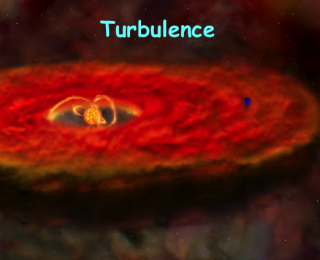
Turbulence plays a key role in determining what types of planets can form in a disk. We are finally on the verge of measuring this property for the first time using CO spectral lines, but it will only work if we factor in how quickly CO can be depleted.
Can gas giant planets form through pebble accretion?

Can gas giant planets form through pebble accretion?

by Michael Hammer | Sep 13, 2017 | Daily Paper Summaries

Giant planets take too long to form from large planetesimals. Does including much smaller pebbles fix this problem?
Will the real Protoplanetary Disk Mass please stand up?

Will the real Protoplanetary Disk Mass please stand up?

by Michael Hammer | May 22, 2017 | Daily Paper Summaries

My name is Protoplanetary Disk Mass. I am important for determining what types of planets can form, where they can form, and how quickly they can form. Signed Protoplanetary Disk Mass.

Stuff Between the Stars: Gas, Dust, and… Asteroids?

Stuff Between the Stars: Gas, Dust, and… Asteroids?

by Kerrin Hensley | Apr 10, 2017 | Daily Paper Summaries

Interstellar space should be littered with debris ejected during the formation of planetary systems—but how much? Engelhardt et al. use solar system surveys and simulations to place an upper limit on the number density of asteroids and comets roaming the Milky Way without a parent star.

Bridging the Gap: A Stellar Way to Identify Planets in Protoplanetary Disks

Bridging the Gap: A Stellar Way to Identify Planets in Protoplanetary Disks

by Jamila Pegues | Mar 6, 2017 | Daily Paper Summaries

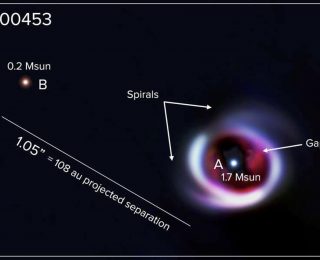
Characterizing planets through direct imaging is no easy task! But today’s authors offer a work-around formula, which estimates the crucial parameter of planetary mass from protoplanetary disk observations. In this astrobite, we discuss ‘The Theory’ and ‘The Practice’ of their cool equation.

Rings of Dust

Rings of Dust

by Elisabeth Matthews | Feb 14, 2017 | Daily Paper Summaries

In this bite, we talk about observations of substructure in a young circumstellar debris disk. What can the formation of multiple debris dust rings tell us?

« Older Entries
Next Entries »

Loading

Follow our socials

  • Bluesky
  • Facebook
  • Instagram
  • RSS Feed

More Posts About

AAS AGN astronomy astrophysics binary stars black holes cosmology dark matter dwarf galaxies exoplanets galaxies galaxy evolution gravitational waves habitability JWST Kepler Milky Way observations planetary science planet formation protoplanetary disks radio astronomy simulations solar system spectroscopy star formation stars stellar evolution supernovae theory

Posts by Category

  • Accessibility
  • Applications
  • Beyond
  • Book Reviews
  • Career Navigation
  • Classics
  • Climate Change
  • Course Assignments
  • Crossposts
  • Current Events
  • Daily Paper Summaries
  • Game Reviews
  • Guides
  • Historical Astronomy
  • Instrumentation
  • Interviews
  • Outreach
  • Personal Experiences
  • PRJ
  • Quick Notes
  • Satellites
  • Teaching
  • Undergraduate Research

More Astronomy

  • AAS
  • AAS Nova
  • astro-ph
  • AstroBetter
  • APOD

Read Astrobites in Other Languages

  • Astrobitos (Spanish)
  • Astropontos (Portuguese)
  • staryab (Farsi)

Listen to Astrobites

  • astro[sound]bites

Discover More Incredible Science

  • ScienceBites Network
  • RSS

© 2026 Astrobites | All Rights Reserved | Supported by AAS | Designed by Elegant Themes | Powered by WordPress