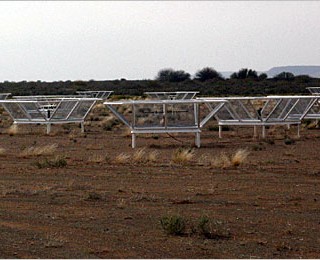
Closing In on the Epoch of Reionization
An array of dipole antennas in South Africa’s Karoo desert offers the best limit on the power spectrum of the Epoch of Reionization.

An array of dipole antennas in South Africa’s Karoo desert offers the best limit on the power spectrum of the Epoch of Reionization.
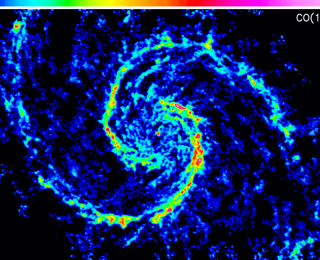
It’s big, it’s active, and it’s only 20 million lightyears away– it is the Whirlpool galaxy, and astronomers are getting a brand new view. Using the Plateau de Bure interferometer, this paper examines the gas in this nearby grand-design spiral galaxy on arcsecond scales, resolving for the first time its individual molecular clouds. What does this tell us about star formation in this galaxy? Stay tuned!
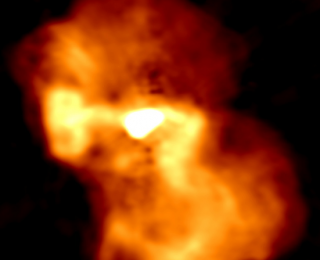
Check out these cool new results from LOFAR which is boldly going to some of the longest wavelengths astronomers have ever observed! An active galaxy has a less active past than we might expect, pulsating neutron stars are behaving strangely, and even at wavelengths as long as meters, there are still spectral lines from extremely low-energy atomic transitions.
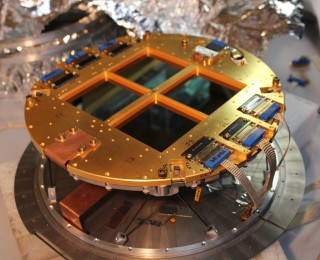
I’m spending a month at the South Pole working on a CMB telescope. In this installment, I measure the telescope’s sidelobes and close up a receiver.
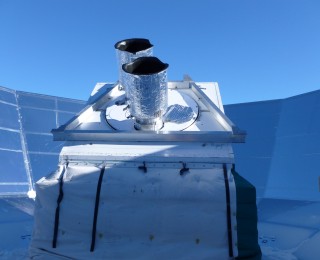
I’m spending a month working on a telescope at the South Pole. In this post, we take a tour of the two observatory buildings hosting Cosmic Microwave Background experiments.
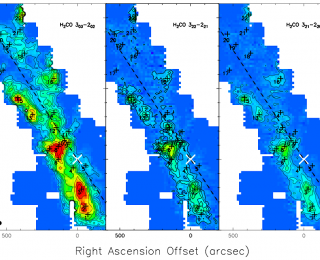
Unlike its candy bar namesake, the center of our Milky Way Galaxy is not actually a very pleasant place to be. There’s a supermassive central black hole to deal with, intense radiation from a population of massive stars, and hot clouds of molecular gas. In this paper, the authors use observations of three molecular spectral lines to measure the temperatures of these gas clouds in the center of the Galaxy, and find that the processes heating the clouds may not be what you expect!