• RSS
  • Submit a Guest Post
  • Undergraduates: Submit your Research!
  • Suggest a Paper Topic!
astrobites
  • About
    • About Astrobites
    • Meet the Authors
    • Statement of Inclusivity
    • Copyright & Permissions
  • Latest Research
    • Daily Paper Summaries
    • Classics
    • Undergrad Research
    • Physical Review Coverage
  • Beyond astro-ph
    • Beyond astro-ph Library
    • Interviews
    • Career Navigation
    • Personal Experiences
    • Current Events
    • Teaching with Astrobites
  • Guides
    • EM Spectrum
    • Galaxies & AGNs
    • Spectroscopy and Spectral Lines
    • Adaptive Optics
    • Gravitational Waves
    • Transient Astronomy
    • Astrophysical Software
    • Graduate School
    • Writing a personal statement for grad apps
    • First Observing Run
    • …More Guides!
Select Page
UR #32: Simulations of Black Hole Evolution over Cosmic Time Periods

UR #32: Simulations of Black Hole Evolution over Cosmic Time Periods

by Astrobites | Oct 29, 2020 | Undergraduate Research

Today’s undergraduate research post features a student who uses computer simulations to simulate black holes and how they evolve over billions of years.
Do Aluminum Abundances Foil Our Theory of Galaxy Evolution?

Do Aluminum Abundances Foil Our Theory of Galaxy Evolution?

by Michael Foley | Jul 20, 2020 | Daily Paper Summaries

Aluminum can be used for so much more than foil. What can it tell us about our solar system’s place in the galaxy? Read about today’s paper to find out more.

One Dark Matter Profile Please, Hold the Subhaloes

One Dark Matter Profile Please, Hold the Subhaloes

by Luna Zagorac | Jul 15, 2020 | Daily Paper Summaries

When we observe galaxies and measure their dark matter halos, we exclude subhaloes from the halo’s mass profile. When we simulate haloes, we include them. But what if we didn’t?

The Formation of Massive Stars

The Formation of Massive Stars

by Mitchell Cavanagh | Jul 6, 2020 | Daily Paper Summaries

New simulations provide insights on the processes behind the formation of massive stars

Rocks Go Wild: How to Make a Solar System

Rocks Go Wild: How to Make a Solar System

by Jenny Calahan | May 29, 2020 | Daily Paper Summaries

How do you form Mercury, Venus, Earth AND Mars? The answer may surprise you! (or not ¯\_(ツ)_/¯)

Enigmatic Explosions: How Different Supernova Models Yield Very Different Galaxies

Enigmatic Explosions: How Different Supernova Models Yield Very Different Galaxies

by Michael Foley | Apr 28, 2020 | Daily Paper Summaries

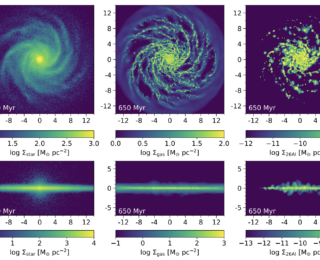
Accounting for the uncertainty in supernova explosion parameters can substantially change the star formation history and morphology of galaxy simulations.

« Older Entries
Next Entries »

Loading

Follow our socials

  • Bluesky
  • Facebook
  • Instagram
  • RSS Feed

More Posts About

AAS AGN astronomy astrophysics binary stars black holes cosmology dark matter dwarf galaxies exoplanets galaxies galaxy evolution gravitational waves habitability JWST Kepler Milky Way observations planetary science planet formation protoplanetary disks radio astronomy simulations solar system spectroscopy star formation stars stellar evolution supernovae theory

Posts by Category

  • Accessibility
  • Applications
  • Beyond
  • Book Reviews
  • Career Navigation
  • Classics
  • Climate Change
  • Course Assignments
  • Crossposts
  • Current Events
  • Daily Paper Summaries
  • Game Reviews
  • Guides
  • Historical Astronomy
  • Instrumentation
  • Interviews
  • Outreach
  • Personal Experiences
  • PRJ
  • Quick Notes
  • Satellites
  • Teaching
  • Undergraduate Research

More Astronomy

  • AAS
  • AAS Nova
  • astro-ph
  • AstroBetter
  • APOD

Read Astrobites in Other Languages

  • Astrobitos (Spanish)
  • Astropontos (Portuguese)
  • staryab (Farsi)

Listen to Astrobites

  • astro[sound]bites

Discover More Incredible Science

  • ScienceBites Network
  • RSS

© 2026 Astrobites | All Rights Reserved | Supported by AAS | Designed by Elegant Themes | Powered by WordPress