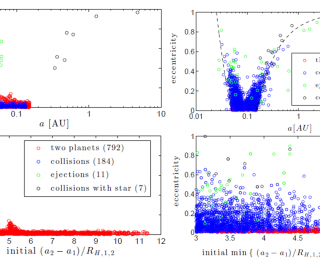
Can Scattering Explain Eccentric Planets?
New dynamical simulations show that close-in planets on eccentric orbits can arise from planet-planet scattering — but only if the scattering occurs on larger orbits and is followed by inward migration.

New dynamical simulations show that close-in planets on eccentric orbits can arise from planet-planet scattering — but only if the scattering occurs on larger orbits and is followed by inward migration.
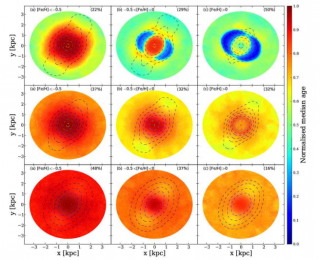
The recent discovery of young stars in the Milky Way’s galactic bulge have raised new questions about galaxy formation. In this paper, a new simulation shows that such stars could be an outcome of natural evolution in the disc over time.
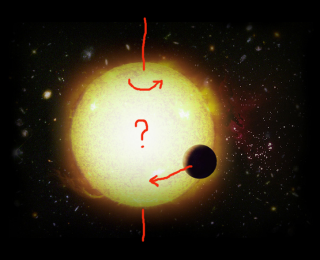
How do so many hot jupiters come to orbit backwards?
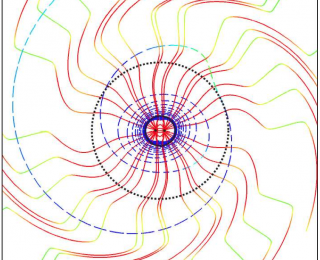
Field lines are a powerful tool for building intuition for a complex geometric object.
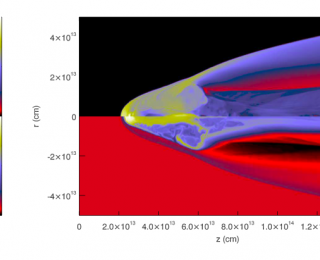
What happens when an astrophysical jet moving at enormous speeds plows into the gas and dust around it? Some of that matter gets dragged along for the ride — and according to this author, this process could create the two different types of jets that we see.
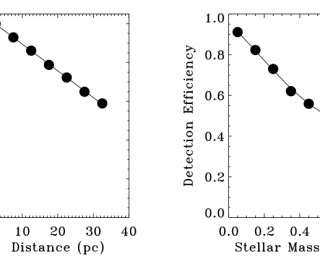
There’s a new space telescope on the block, which just might find as many new planet candidates as the Kepler mission.