by Kim Phifer | May 24, 2013 | Daily Paper Summaries
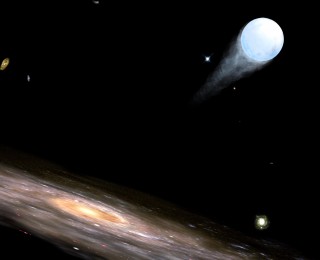
TITLE: Supernovae in the Central Parsec: A Mechanism for Producing Spatially Anisotropic Hypervelocity StarsAUTHORS: Kastytis Zubovas, Graham A. Wynn, Alessia GualandrisAUTHORS’ INSTITUTION: Theoretical Astrophysics Group, University of Leicester Hypervelocity Stars In 2005, Brown et al. discovered a star with a radial velocity of ~700 km/s, which is more than 3 times the Solar velocity! This star is moving so quickly that its velocity is high enough to escape the Milky Way. The existence of such stars, deemed hypervelocity stars (HVSs), was predicted almost 20 years earlier by Hills (1988). The so-called Hills mechanism ejects stars at high speeds from the center of the Galaxy after a binary stellar system gravitationally interacts with the supermassive black hole at the center of the Galaxy. In such a three-body interaction, one star can be ejected at very high speeds while the other remains in the central region of the Galaxy on a highly eccentric orbit. A number of highly eccentric short-period stars are observed in the Galactic center, which suggests associated HVSs may exist. Since the initial discovery of an HVS in 2005, many more have been discovered (see this astrobite). A small warning: the exact definition of HVSs can vary throughout the literature. In this post, stars traveling away from the Galactic center with velocities high enough to have become unbound from the central black hole are referred to as HVSs.While it is very likely that the Hills Mechanism does create HVSs, it is unclear whether all HVSs are created via this method. Curious if there is a supplemental method to produce HVSs, the authors of today’s paper examine the production...
by Allison Strom | Apr 13, 2013 | Daily Paper Summaries
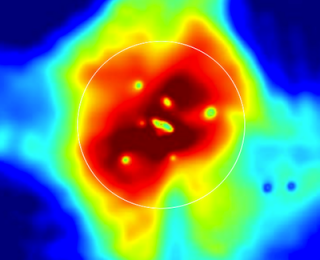
Moving mesh code AREPO looks like it will help astronomers understand the physics of galaxy formation and evolution better than its predecessors, due to an innovative new method of solving the fluid dynamics equations in astrophysical settings. This paper discusses the differences between AREPO and another code called GADGET in the case of gas accretion onto galaxies.
by Betsy Mills | Feb 20, 2013 | Daily Paper Summaries
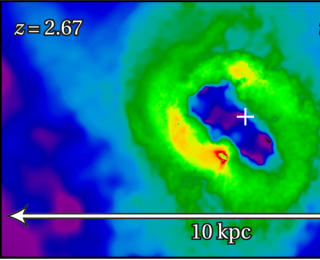
What were astronomers reading and talking about in their research last year? Check out figures from the top 12 most-cited astronomy papers from 2012 (so far) and find out what researchers were up to and why!
by Jessica Donaldson | Feb 17, 2013 | Daily Paper Summaries
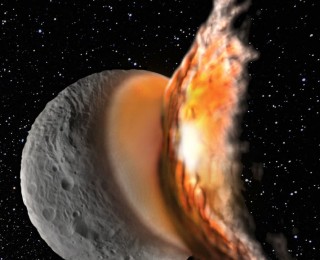
The asteroid Vesta has been scared by two giant impacts, dredging up material from deep below its surface. New simulations of the impacts allow us to trace where the material should end up and creates a conflict between theory and observation.
by Kim Phifer | Feb 5, 2013 | Daily Paper Summaries
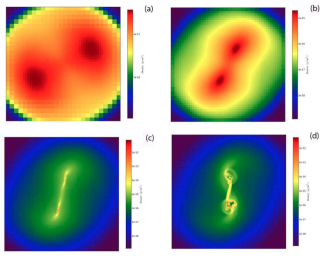
Boss & Keiser examine how magnetic fields with varying initial conditions affect star formation.
by Nick Ballering | Jan 28, 2013 | Daily Paper Summaries
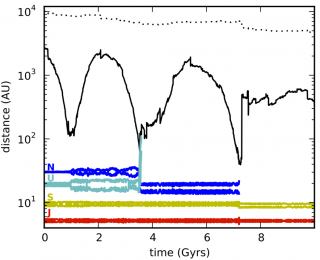
New simulations show that — due to forces from outside the stellar system — wide stellar binaries may disrupt planets much more than previously thought.
