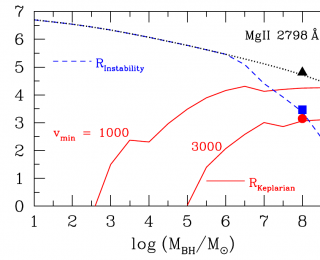
Can you hide a super-massive black hole?
Observational surveys looking for the smallest super-massive black holes come up empty; could they be hiding in plain sight?

Observational surveys looking for the smallest super-massive black holes come up empty; could they be hiding in plain sight?
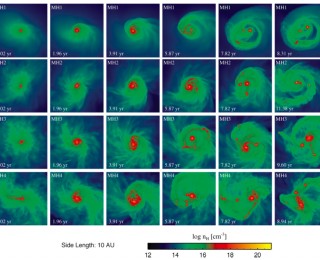
In a recent paper, Stacy et al. reveal the detailed internal structure of the seeds of four of the first stars, and demonstrate for the first time that they are rapidly spinning throughout. Their results bring us one step closer to a coherent story of the lives and deaths of Population III stars.
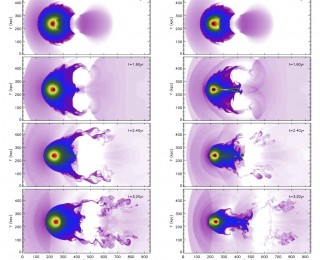
Most simulations to date have implied that satellite galaxies traveling through galaxy clusters are stripped of gas for future star formation in a process known as “strangulation”. In contrast, the authors of this paper suggest that satellite galaxies may not be as cut off as some might think: instead, their simulations show that the cooler, stripped gas from the corona will mix with the surrounding intra-cluster medium and remain near the original galaxy as a potential new source of star-forming fuel.
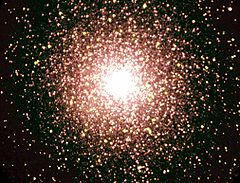
Globular clusters are some of the most massive and densest star clusters observed. What are the progenitors of old globular clusters that we see orbiting the Milky Way and other galaxies? What evolutionary and dynamical effects have these clusters experienced? What determines the physical properties of old globular clusters? Why are there two “distinct” classes of globular clusters and what properties determine these physical states? These are the questions the authors aim to answer.
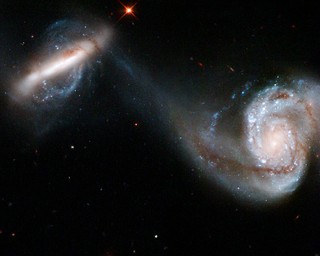
Ever wondered what it’s like to merge galaxies? The authors of the Galaxy Zoo project have created a way that you can find out… and do science while you’re at it!
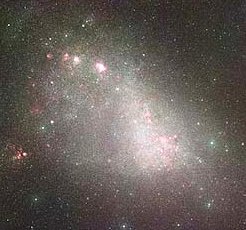
In this paper, the authors describe a new galaxy simulation that includes molecular hydrogen, the site of star formation, and discuss what happens with and without it.