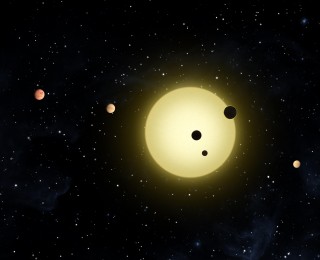
How to Build a Low-Density Super-Earth
Many Super-Earths appear to be less dense than the Earth. How do such planets form? Could a rocky Super-Earth accrete a hydrogen-helium atmosphere in-situ?

Many Super-Earths appear to be less dense than the Earth. How do such planets form? Could a rocky Super-Earth accrete a hydrogen-helium atmosphere in-situ?
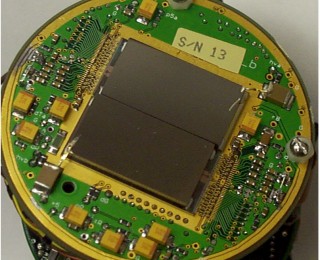
Why are there so few X-ray imaging polarimeters? This paper determines the intrinsic sensitivity of stacked imaging detectors to hard X-ray polarization.
What happens to planets in binary star systems when the primary star evolves off the main sequence? Can the planet survive?
Living metal-poor stars represent the fossil records of the early cosmic star formation.
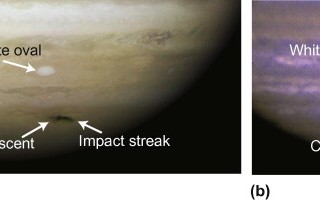
The impact of comet Shoemaker-Levy 9 was a remarkable event: in 1994, a comet, torn into pieces during a close approach with Jupiter two years prior, crashed into Jupiter. It was the first collision between two solar system bodies to ever be observed, and the effects on Jupiter’s atmosphere (see the figure below) were visible for months. At the time, Harrington et al. (2004) predicted that it would be hundreds of years before such an event occurred again. But two and a half years ago, another object collided with Jupiter. No one witnessed the collision, but amateur astronomer A. Wesley noticed a dark streak with properties closely matching those seen after the impact of SL-9. Because of these similarities, it is believed that this feature was the result of an impact.
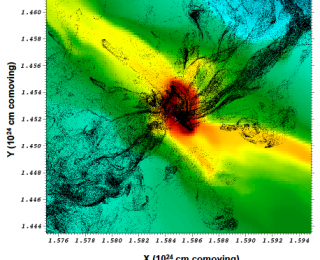
What if the first stars were only 1-50 times as massive as the Sun? Would they still be able to enrich the intergalactic medium and trigger the birth of the next generation of stars?