by Caroline Morley | May 9, 2013 | Daily Paper Summaries
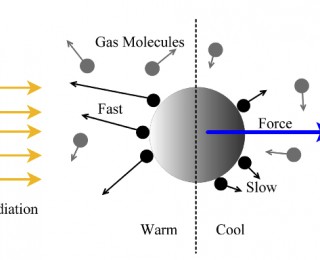
Mercury’s high density has been a longstanding puzzle in planetary science. Its density means that it must have a significantly higher iron abundance than Venus, Earth, Mars, or the asteroids, probably in the form of a large iron core. NASA’s MESSENGER mission has challenged many of the hypothesized ways to create an iron-rich Mercury; a new hypothesis is required.
by Ben Montet | Mar 8, 2013 | Daily Paper Summaries
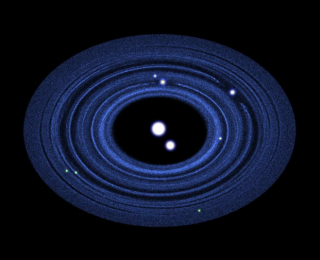
The number of known moons of Pluto has now reached five. What are they like, and how did they get there? Kenyon and Bromley use numerical simulations to answer these questions and determine what else New Horizons may find in 2015.
by Joseph O'Rourke | Mar 3, 2013 | Daily Paper Summaries
A pair of Colombian scientists has made the first attempt to figure out the meteoroid that exploded over Russia last month.
by Erika Nesvold | Feb 7, 2013 | Daily Paper Summaries
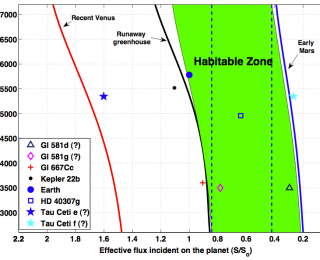
In our search for life on other planets, we begin by determining which exoplanets orbit in the habitable zone of their star. But where exactly is the habitable zone for a given star? The authors of this paper update a previous planetary climate model to predict where you should looking for your next extrasolar vacation home.
by Elizabeth Lovegrove | Jan 29, 2013 | Daily Paper Summaries
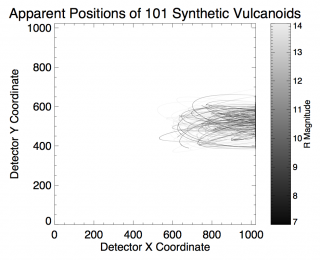
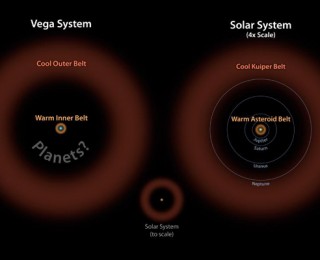
TITLE: A Search for Vulcanoids with the STEREO Heliospheric Imager AUTHORS: A. J. Steffl, N. J. Cunningham, A. B. Shinn, D. D. Durda, S. A. Stern FIRST AUTHOR’S INSTITUTION: Southwest Research Institute, BoulderThe recent evidence for an asteroid belt in the Vega system highlights how well we’re getting to know the solar systems around other stars. But there are some surprising gaps in our knowledge of our own. Inwards of the orbit of Mercury, there exists a dynamically stable region between about 0.21 AU and 0.07 AU where objects can orbit without being perturbed by Mercury or vaporized by the Sun. As far back as 1859 astronomers proposed that there might be at least one small planet lurking in this region, at the time a potential explanation for the odd precession of Mercury, and gave this hypothetical world the name “Vulcan”. Although Mercury’s orbital behavior was later explained by Einstein using general relativity, the idea of close-in planetesimals called “Vulcanoids” stuck around. The orbital motions of Mercury, Venus, and the Sun rule out a planet, but there’s still room for smaller objects. We now know that many, many exoplanet systems feature full-blown planets that orbit far closer in to their stars than Mercury does to the Sun. Why not some debris in ours?But how could something comparatively right next door go undetected for so long? Their very closeness to the Sun makes them hard to see. From Earth’s perspective, objects in the Vulcanoid region never stray farther than about 12 degrees from the Sun in the sky. From the ground they can only be observed in the early twilight, and...
by Jessica Donaldson | Jan 20, 2013 | Daily Paper Summaries
A new asteroid belt discovered around Vega makes this system look more similar to the Solar System than we had previous thought. The gap between the two belts around Vega may indicate the presence of multiple planets.
