by Susanna Kohler | May 14, 2012 | Daily Paper Summaries
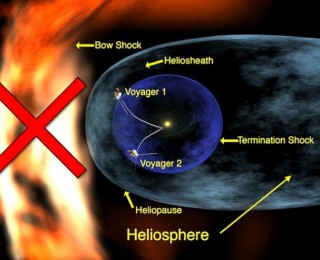
Recent data from IBEX has revealed that our decades-old model of the heliosphere is wrong: there is no bow shock ahead of the heliosphere in the ISM.
by Courtney Dressing | Mar 29, 2012 | Daily Paper Summaries
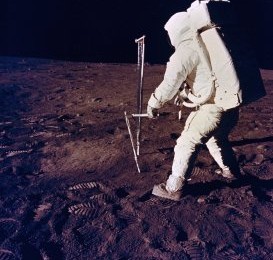
Are robotic missions really more efficient than human space exploration? Ian Crawford explains why planetary astronomers should support human space exploration.
by Elisabeth Newton | Mar 28, 2012 | Daily Paper Summaries
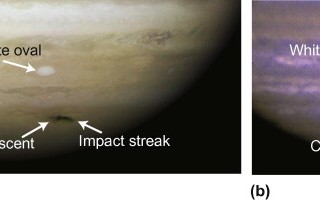
The impact of comet Shoemaker-Levy 9 was a remarkable event: in 1994, a comet, torn into pieces during a close approach with Jupiter two years prior, crashed into Jupiter. It was the first collision between two solar system bodies to ever be observed, and the effects on Jupiter’s atmosphere (see the figure below) were visible for months. At the time, Harrington et al. (2004) predicted that it would be hundreds of years before such an event occurred again. But two and a half years ago, another object collided with Jupiter. No one witnessed the collision, but amateur astronomer A. Wesley noticed a dark streak with properties closely matching those seen after the impact of SL-9. Because of these similarities, it is believed that this feature was the result of an impact.
by Lauren Weiss | Feb 10, 2012 | Quick Notes
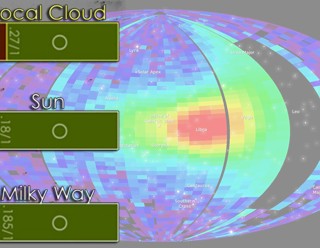
One of the most important elements for complex life on Earth is oxygen. In a recent publicity video, NASA explained how its IBEX Mission found that the solar system is oxygen-rich compared to its surroundings. The original press release is here, and the results were published in a series of six articles in the Astrophysical Journal – you (or your institution) need a subscription to see the ApJ article.The IBEX Mission measured the ratio of neon to oxygen in neutral atoms that slipped through our Solar System’s protective heliosphere (neutral particles are not affected by its magnetic field, so they pass right through) and determined that there is more oxygen for each neon atom inside our Solar System than outside. The Mission scientists posit two theories to explain the relative over-abundance of oxygen in our solar system: (1) the sun originally formed in a part of the galaxy with an oxygen abundance different from that of our current location, or (2) much of the oxygen of the interstellar medium (the space between stars) is trapped in grains of ice and dust, and was thus not detected by the IBEX Mission. Either explanation could have important implications for astrobiology, and for understanding the formation of our solar system and...
by Elisabeth Newton | Jan 18, 2012 | Daily Paper Summaries
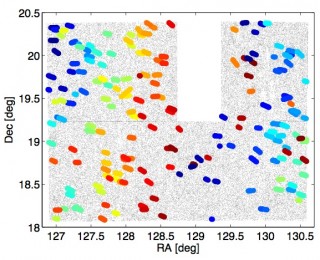
Title: Asteroid rotation periods from the Palomar Transient Factory survey Authors: D. Polishook, E. O. Ofek, A. Waszczak, S. R. Kulkarni, A. Gal-Yam, O. Aharonson, R. Laher, J. Surace, C. Klein, J. Bloom, N. Brosch, D. Prialnik, C. Grillmair et al. First Author’s Institution: Benoziyo Center for Astrophysics, Weizmann Institute of Science, IsraelDetermination of the rotation periods of asteroids has a number of applications. When considering an asteroid individually, it can help one to understand the physical properties of an individual asteroid, including its shape and whether or not it’s a binary. In a statistical sense, the rotations of the entire population of asteroids can help one to understand the physical processes that govern asteroid rotation. The two mechanisms that influence an asteroid’s rotatation are collisions and something called the YORP effect, in which photons from the Sun are actually able to accelerate asteroids through absorption and re-emission. There’s a nice discussion of this type of science which includes a description of the YORP effect in this Cornell press release, while this Discovery news story reports on the first direct detection of the YORP effect (which combines the initials of four different people).*Currently there are 3,700 asteroids with measured rotation periods; using the Palomar Transient Factory, these authors aim to eventually measure rotation periods for 10,000 asteroids. (PTF also finds supernovae, see for example this discovery). In this paper, Polishook et al. report on the identification of 624 asteroids in the PTF survey, 20% of which are new discoveries, and 88 new rotation period measurements. All of the asteroids identified belong to the main asteroid belt. The smallest asteroids...
by Shannon Hall | Jan 16, 2012 | Daily Paper Summaries
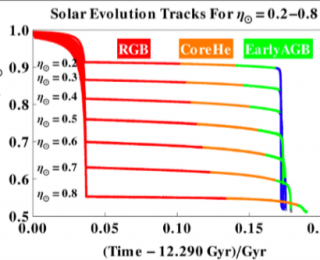
In 6 Gyrs the Sun will stop fusing Hydrogen in its core. It will then go through several phases of post-main sequence evolution. Depicted here are models spanning a range of plausible evolutionary sequences and how such phases might effect the dynamics of the Solar System.
