• RSS
  • Submit a Guest Post
  • Undergraduates: Submit your Research!
  • Suggest a Paper Topic!
astrobites
  • About
    • About Astrobites
    • Meet the Authors
    • Statement of Inclusivity
    • Copyright & Permissions
  • Latest Research
    • Daily Paper Summaries
    • Classics
    • Undergrad Research
    • Physical Review Coverage
  • Beyond astro-ph
    • Beyond astro-ph Library
    • Interviews
    • Career Navigation
    • Personal Experiences
    • Current Events
    • Teaching with Astrobites
  • Guides
    • EM Spectrum
    • Galaxies & AGNs
    • Spectroscopy and Spectral Lines
    • Adaptive Optics
    • Gravitational Waves
    • Transient Astronomy
    • Astrophysical Software
    • Graduate School
    • Writing a personal statement for grad apps
    • First Observing Run
    • …More Guides!
Select Page
An H II Region Walks into A Bar

An H II Region Walks into A Bar

by Jesse Feddersen | Sep 1, 2016 | Daily Paper Summaries

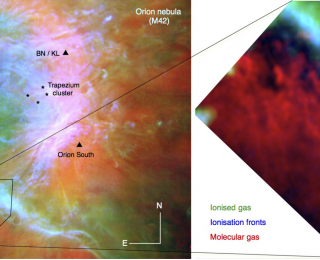
High resolution observations of the Orion Nebula show a complex collision between two extreme types of gas.

There are weird dots in the sky…

There are weird dots in the sky…

by Ingrid Pelisoli | Aug 5, 2016 | Daily Paper Summaries

Sometimes a mystery can hide in apparently plain things. Astronomers have just discovered that a delta Scuti star known for over 40 years is actually something entirely different and full of peculiarities.
Image via M. Garlick/University of Warwick, ESA/Hubble.

Mass Loss in Dying Stars

Mass Loss in Dying Stars

by Caroline Huang | Jul 21, 2016 | Daily Paper Summaries

By the time a star becomes a white dwarf, much of its mass will have been lost. When does this mass loss occur and what drives it? Read today’s astrobite to find out.

The Centre of Attention

The Centre of Attention

by Mara Johnson-Groh | May 6, 2016 | Daily Paper Summaries

Deep imaging of a nearby dwarf galaxy reveals a new globular cluster.

Mapping Gravity in Stellar Nurseries

Mapping Gravity in Stellar Nurseries

by Jesse Feddersen | May 2, 2016 | Daily Paper Summaries

Gravity turns gas into stars. Today’s astrobite introduces a new way to study gravity’s pull in a molecular cloud – the birthplace of new stars.

Double Bubble Galaxy

Double Bubble Galaxy

by Mara Johnson-Groh | Mar 30, 2016 | Daily Paper Summaries

M31 discovered to be blowing vast bubbles of gamma rays, just like our own galaxy.

« Older Entries
Next Entries »

Loading

Follow our socials

  • Bluesky
  • Facebook
  • Instagram
  • RSS Feed

More Posts About

AAS AGN astronomy astrophysics binary stars black holes cosmology dark matter dwarf galaxies exoplanets galaxies galaxy evolution gravitational waves habitability JWST Kepler Milky Way observations planetary science planet formation protoplanetary disks radio astronomy simulations solar system spectroscopy star formation stars stellar evolution supernovae theory

Posts by Category

  • Accessibility
  • Applications
  • Beyond
  • Book Reviews
  • Career Navigation
  • Classics
  • Climate Change
  • Course Assignments
  • Crossposts
  • Current Events
  • Daily Paper Summaries
  • Game Reviews
  • Guides
  • Historical Astronomy
  • Instrumentation
  • Interviews
  • Outreach
  • Personal Experiences
  • PRJ
  • Quick Notes
  • Satellites
  • Teaching
  • Undergraduate Research

More Astronomy

  • AAS
  • AAS Nova
  • astro-ph
  • AstroBetter
  • APOD

Read Astrobites in Other Languages

  • Astrobitos (Spanish)
  • Astropontos (Portuguese)
  • staryab (Farsi)

Listen to Astrobites

  • astro[sound]bites

Discover More Incredible Science

  • ScienceBites Network
  • RSS

© 2026 Astrobites | All Rights Reserved | Supported by AAS | Designed by Elegant Themes | Powered by WordPress