by Jesse Feddersen | Oct 14, 2015 | Daily Paper Summaries
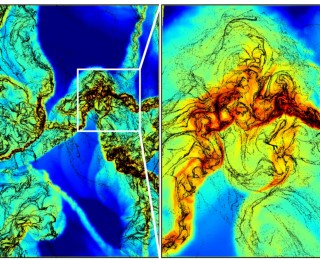
Molecular clouds, where new stars are born, are made of two components: gas and dust. The gas is mostly hydrogen, and the dust is made of elements crucial for forming planets and people, like silicon and carbon. Today’s paper shows that these two components behave very differently in a simulated molecular cloud. This could have exciting consequences for the growth of dust and the formation of stars and planets.
by Anson Lam | Sep 8, 2015 | Daily Paper Summaries
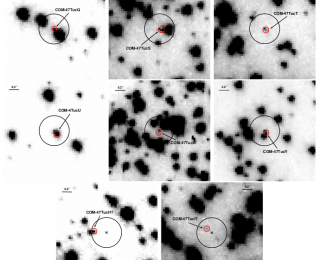
Images from the Hubble Space Telescope show that there are previously unknown white dwarfs orbiting around pulsar companions.
by Gudmundur Stefansson | Sep 2, 2015 | Daily Paper Summaries
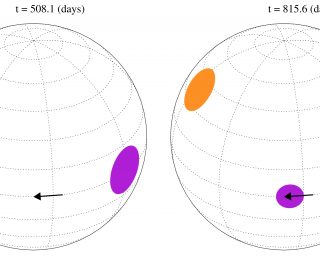
On using photometric data from Kepler to study starspots, and to measure differential rotation rates.
by Meredith Rawls | Aug 4, 2015 | Daily Paper Summaries
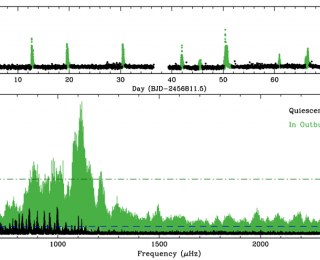
This variable white dwarf pulsates as expected, but it also experiences very bright outbursts. Today’s paper takes us through the discovery and verification of the second pulsating white dwarf with outbursts, and speculates how the pulsations and outbursts may be linked.
by Caroline Huang | Jul 31, 2015 | Daily Paper Summaries
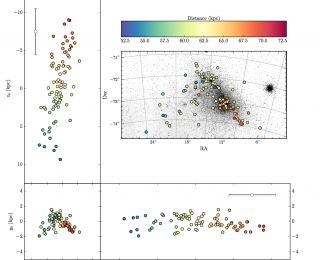
In today’s paper, the authors use Cepheid distance moduli to study the structure of the SMC.
by Tim Lichtenberg | Apr 28, 2015 | Daily Paper Summaries
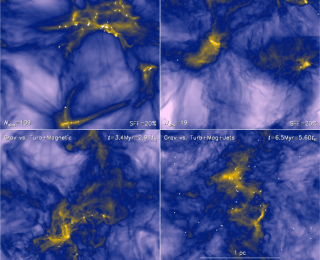
Stars form via gravitational collapse of molecular cloud cores. But observations reveal that far less gas is turned into stars than you would suspect by naively calculating the star formation rate. So what can we do about this mismatch?
