by Ben Montet | Dec 10, 2013 | Classics, Daily Paper Summaries
Today we take a look back to 1916, when distances were measured in light years and uncertainties weren’t to be included in publications. The nearly 100-year old discovery of a small star has large implications for our understanding of stellar astrophysics, even today.
by Anson Lam | Nov 25, 2013 | Daily Paper Summaries
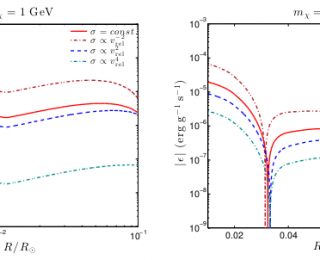
Depending on how they scatter with nuclei, dark matter particles might affect the structure and evolution of our Sun.
by Meredith Rawls | Nov 12, 2013 | Daily Paper Summaries
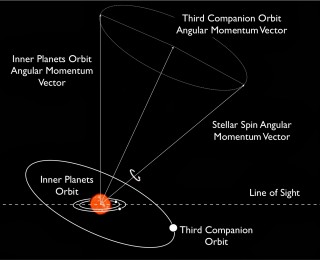
Our Solar System is pretty straightforward. Roughly speaking, all the planets orbit in the same plane, most spin on their axes in the same direction in that plane, and even the Sun rotates in a manner consistent with all this. The small, rocky planets are closer to the Sun, and the big, gaseous planets are farther from the Sun. Simple. Now that we are finding planets orbiting other stars, many are turning out to be multiplanet systems like our own Solar System.
by Nick Ballering | Nov 4, 2013 | Daily Paper Summaries
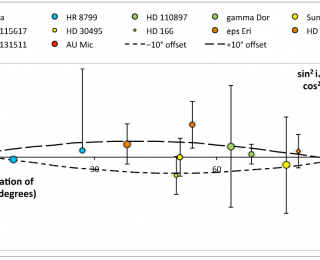
Herschel observations reveal that debris disks are aligned with their stars’ equators, unlike some close-in transiting exoplanets.
by Ben Montet | Nov 3, 2013 | Personal Experiences
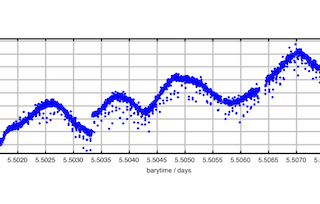
Part two of our recap of the “Modern Statistical and Computational Methods for Analysis of Kepler Data” workshop in North Carolina, featuring both astronomers and statisticians!
by Ben Montet | Nov 2, 2013 | Personal Experiences
A recap of the “Modern Statistical and Computational Methods for Analysis of Kepler Data” workshop in North Carolina, featuring both astronomers and statisticians!
