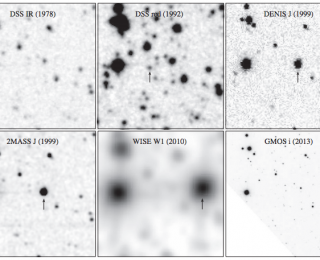
Checking Out Our New Neighbors
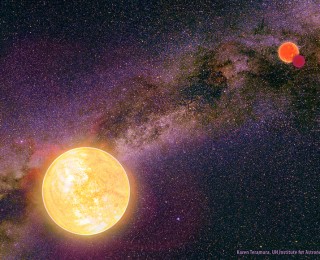
A new brown dwarf system has been discovered only 2 parsec away; Gillon et al. analyze its light curve to study clouds on the surfaces of these stars.

A new brown dwarf system has been discovered only 2 parsec away; Gillon et al. analyze its light curve to study clouds on the surfaces of these stars.
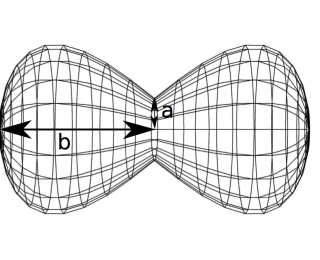
Novae are thermonuclear explosions that occur on the surface of a white dwarf following the accretion of matter from a nearby companion star. The authors seek to understand the geometry and velocity of the ejected material.
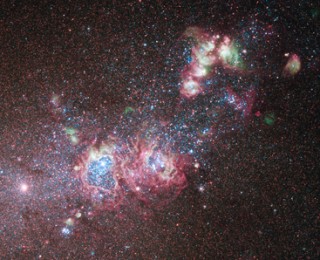
Hubble observations of a nearby galaxy show evidence for a universal initial mass function.
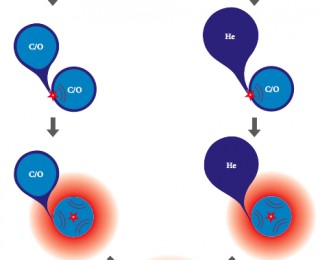
Pakmor et al. propose a new mechanism to make Type 1a supernova explosions from a pair of white dwarfs.
By looking for variations in the observed periods for eclipsing binary stars, astronomers have found evidence that a sizable fraction of these systems are actually systems of three or more stars.
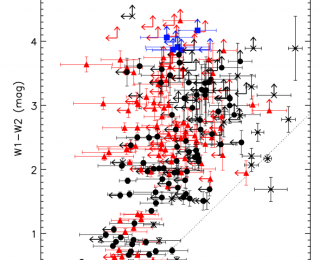
With the addition of these 87 new T dwarfs, WISE has now tripled the number of known T dwarfs with spectral type later than T5.